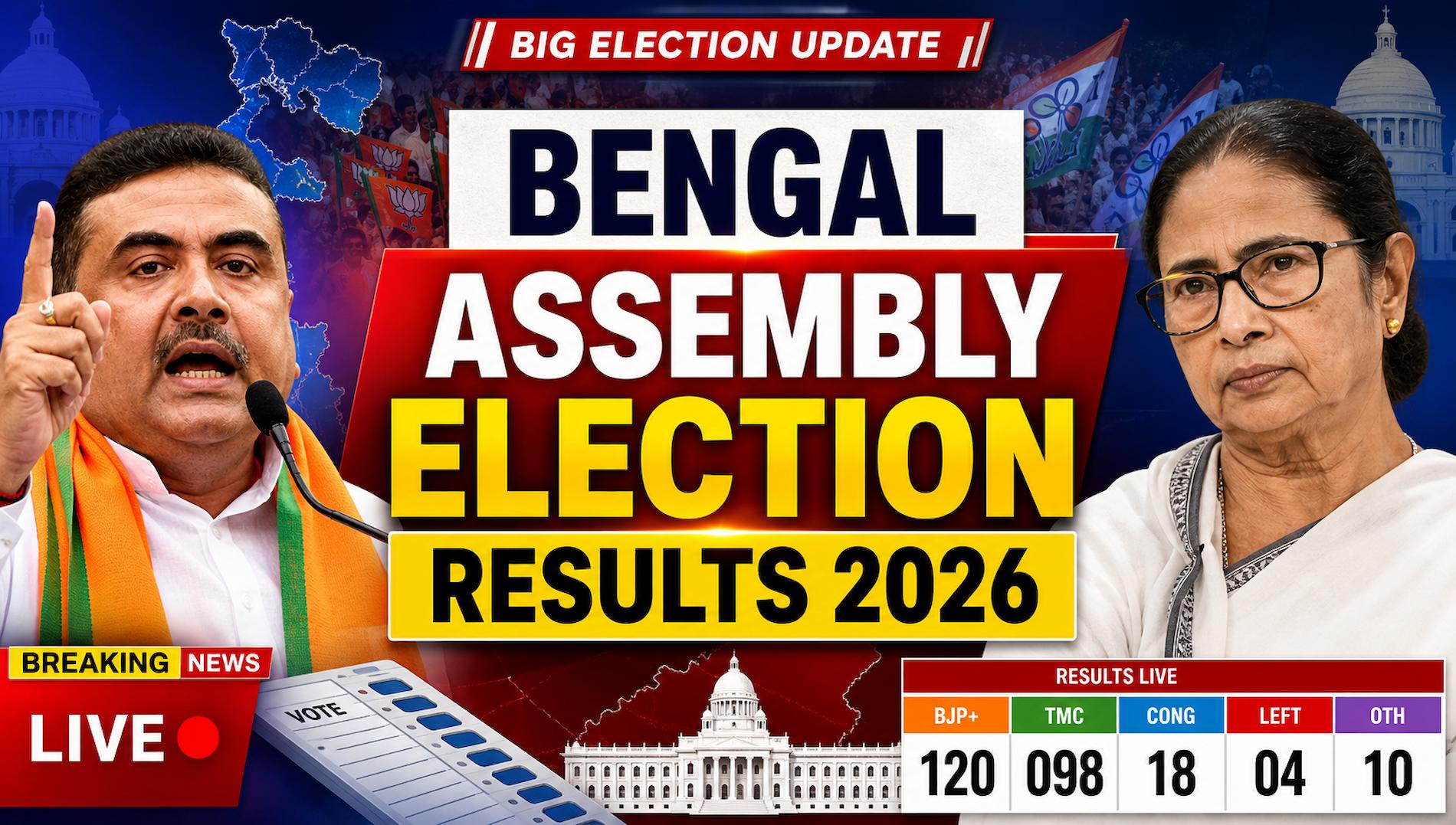
The Bengal Assembly Election Results 2026 have redrawn India’s political map. BJP stormed West Bengal with a historic landslide, ending Trinamool Congress dominance, while Suvendu Adhikari defeated Mamata Banerjee in Bhabanipur by over 15,000 votes. This dramatic verdict signals Bengal’s biggest political upheaval in decades and reshapes national power equations.
Introduction
The Bengal Assembly Election Results 2026 have delivered one of the most dramatic political reversals in modern Indian electoral history. In a seismic shift, the Bharatiya Janata Party crossed the majority mark in West Bengal with more than 200 seats, dismantling the Trinamool Congress’s long-standing control over one of India’s most politically symbolic states. The election’s defining moment came from Bhabanipur in South Kolkata, where Suvendu Adhikari defeated Chief Minister Mamata Banerjee in her own stronghold by 15,105 votes. For the BJP, this is a historic eastern breakthrough. For TMC, it marks an unprecedented collapse. From Kolkata to North Bengal, the verdict reflects anti-incumbency, shifting urban loyalties, and a transformed political landscape.
Key Takeaways
- Phase 1 polling: April 23, 2026 (152 seats)
- Phase 2 polling: April 29, 2026 (142 seats)
- Exit polls released: April 29, 2026
- Counting began: 8:00 AM IST, May 4, 2026
- Total seats: 294
- Majority mark: 148
- BJP: 200+ seats (approx. 207)
- TMC: Around 80 seats
- Congress + Left: Marginal
- Overall turnout: 92.47%
- Phase 1 turnout: 93.19%
- Phase 2 turnout: 91.66%
- Bhabanipur winner: Suvendu Adhikari
- Suvendu votes: 73,917 (53.02%)
- Mamata Banerjee defeated by: 15,105 votes
Bengal Assembly Election 2026 Timeline: A Two-Phase Political Battle
The Bengal Assembly election 2026 unfolded across two intense phases. Phase 1 on April 23 covered 152 constituencies. Phase 2 on April 29 covered the remaining 142 seats.
This two-stage process heightened national scrutiny. Exit polls were published after voting ended on April 29. Official counting started on May 4. By evening, the broad statewide outcome was unmistakable: BJP had rewritten Bengal’s political script. BJP also got major leads in other state assembly elections 2026.
West Bengal Election Results 2026: BJP Majority Bengal 2026 Becomes Reality
The final West Bengal election results 2026 reflected a historic shift. BJP secured more than 200 seats, comfortably crossing the 148-seat majority threshold.
TMC, which won 213 seats in 2021, fell to around 80 seats. Congress and Left alliances remained electorally marginal.
This BJP majority Bengal 2026 is among the largest electoral swings in Indian state politics.
Kolkata Election Result Bhabanipur: Mamata Banerjee Loss 2026 Shocks Bengal
The defining symbol of this election was the Kolkata election result in Bhabanipur.
Bhabanipur had long been Mamata Banerjee’s political fortress. Yet in 2026, Suvendu Adhikari transformed it into the BJP’s biggest symbolic battlefield.
Bhabanipur Final Numbers
- Suvendu Adhikari (BJP): 73,917 votes
- Vote share: 53.02%
- Mamata Banerjee (TMC): Lost by 15,105 votes
This Mamata Banerjee loss 2026 is being described as the symbolic collapse of TMC’s emotional and political centre.
Suvendu Adhikari Victory Bengal: Giant-Slayer Moment
The Suvendu Adhikari victory Bengal is deeply personal and political. Once a senior TMC figure, Adhikari became the BJP’s most potent Bengal challenger.
His win over Mamata in Bhabanipur is more than constituency arithmetic. It represents ideological reversal, organizational expansion, and leadership reinvention.
From Nandigram to Bhabanipur, Adhikari has emerged as the BJP’s defining Bengal face.
Bengal Voter Turnout 2026: Record Participation
The Bengal voter turnout 2026 was extraordinary. West Bengal recorded approximately 92.47% turnout, among India’s highest-ever assembly participation rates.
Phase-Wise Turnout
- Phase 1: 93.19%
- Phase 2: 91.66%
This scale of participation suggests Bengal voters viewed 2026 as a transformative election.
Political Parties Bengal: Who Won and Who Collapsed
The contest centred around the major political parties Bengal has long followed.
BJP
- Emerged as a dominant force
- Massive seat gains
- Strong urban and semi-urban growth
TMC
- Faced historic losses
- Lost Bhabanipur
- Retained limited rural and minority belts
Congress + Left
- Minimal electoral impact
Comparing Bengal Assembly Results 2026 With 2021
The Bengal assembly results 2026 become even more striking when compared to 2021.
2021
- TMC: 213 seats
- BJP: 77 seats
2026
- BJP: 200+ seats
- TMC: ~80 seats
Net Shift
- BJP gain: 120+ seats
- TMC loss: 130+ seats
This represents one of India’s largest democratic electoral reversals.
Bullet Point Section: BJP’s Biggest Growth Zones
- Kolkata urban expansion
- North Bengal
- Barrackpur
- Kharagpur
- Siliguri
- Mixed-population districts
Bullet Point Section: TMC’s Reduced Influence
- Select rural belts
- Minority-heavy zones
- Limited southern clusters
- Reduced urban foothold
Bengal Political News Today: Why Did TMC Fall?
Current Bengal political news today points to several converging factors:
- Anti-incumbency fatigue
- Corruption allegations
- Governance dissatisfaction
- Strong BJP cadre expansion
- Polarization and identity politics
- Urban middle-class shift
TMC’s once-dominant welfare and populist model appears to have lost enough electoral force in key battlegrounds.
West Bengal Politics Enters a New Era
For decades, West Bengal politics revolved around ideological identity, regional charisma, and anti-central narratives.
The 2026 verdict signals a structural transformation. BJP’s rise suggests Bengal’s electorate is no longer politically insulated from broader national trends.
Bengal Election Winners and Losers: Major Faces
Winners
- Suvendu Adhikari
- BJP central leadership
- Bengal BJP organizational machinery
Losers
- Mamata Banerjee
- TMC’s Kolkata dominance
- Congress-Left relevance
The Bengal election winners and losers narrative is likely to shape Indian political discourse for years.
National Political Significance
West Bengal was once considered the BJP’s most difficult eastern frontier. That has changed.
This victory strengthens the BJP’s broader expansion narrative and weakens the assumption that powerful regional parties are electorally untouchable.
For national politics, Bengal may now become a central strategic state ahead of future parliamentary battles.
Media Reaction: Political Earthquake
Leading observers have described the verdict as a “saffron surge” and “political earthquake.”
Mamata’s defeat in Bhabanipur has amplified that symbolism, turning a state election into a national political milestone.
Conclusion
West Bengal’s 2026 verdict has reshaped both state and national politics through an extraordinary electoral upheaval. BJP’s sweeping rise, TMC’s dramatic fall, and Bhabanipur’s symbolic reversal together mark a defining democratic moment. The outcome may influence not just governance in Bengal but the future trajectory of opposition politics across India.