MLC Election 2026: Four States Deliver Major Political Upsets
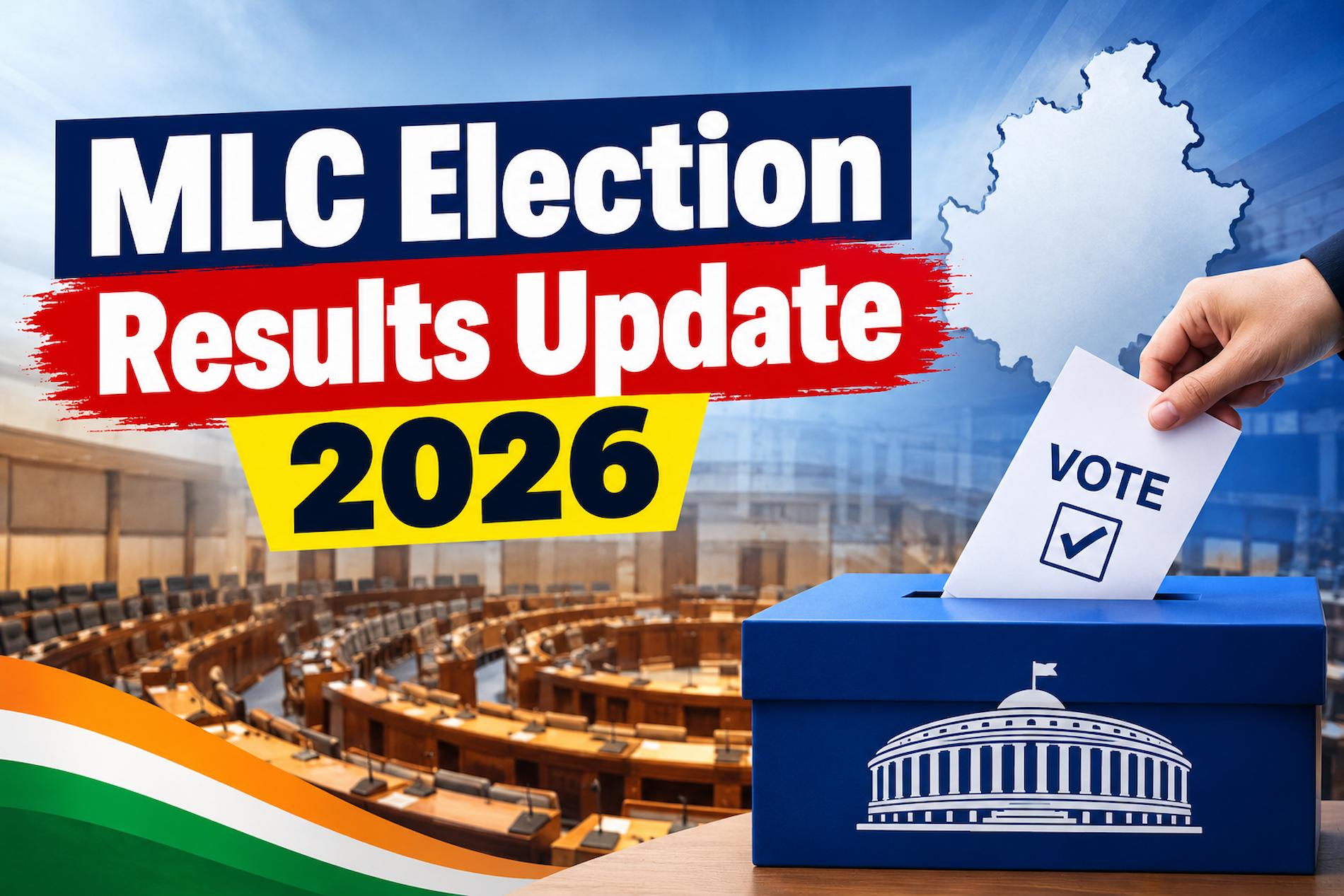
The 2026 Legislative Council elections have produced significant political developments across Uttar Pradesh, Bihar, Maharashtra, and Karnataka. With 28 seats contested, the results have highlighted the BJP’s organizational strength, the Samajwadi Party’s gains, Congress’s mixed performance, and Jan Suraaj’s historic entry into Bihar’s Upper House. The outcome offers fresh insights into regional political alliances ahead of upcoming Assembly elections.
The MLC Election Results update 2026 has brought important political developments across four states, with the Bharatiya Janata Party (BJP), Samajwadi Party, Congress, RJD, and regional parties competing for influence in the Legislative Councils. Vote counting began at 8:00 AM on October 27, following polling held on October 23, 2026.
A total of 28 seats were contested across Uttar Pradesh, Bihar, Maharashtra, and Karnataka. These elections covered registered graduates’ and teachers’ constituencies rather than general Assembly seats. The voting process used the preferential ballot system with 2026 single transferable vote (STV), making second-preference transfers important in several closely fought contests.
The results produced a mixed political picture. The BJP secured six seats in Uttar Pradesh, while the SP finished with five. Bihar witnessed gains for the RJD and a historic victory for Prashant Kishor’s Jan Suraaj Party. Maharashtra’s opposition alliance secured three of five seats, while the BJP-JD(S) partnership swept all four Karnataka constituencies.
Key Takeaways: Six Important Developments
- Four-state elections: A total of 28 MLC seats were contested across four states, with polling on October 23 and counting beginning October 27, 2026.
- Uttar Pradesh: The BJP won six of 11 seats, while the Samajwadi Party secured five, narrowing the gap between the two parties.
- Bihar: The BJP won three seats, the RJD one, JD(U) one, Jan Suraaj one, and Independent candidates two.
- Maharashtra: The Maha Vikas Aghadi (MVA) secured three seats, while the ruling Mahayuti alliance won two.
- Karnataka: The BJP won three seats and JD(S) captured one, defeating Congress in all four constituencies.
- Historic development: Jan Suraaj entered the Bihar Legislative Council for the first time after Suresh Prasad Rai defeated former Congress state president Madan Mohan Jha.
Four States, 28 Seats: Election Overview
| Particulars | Election Details |
|---|---|
| States covered | 4 |
| Total seats | 28 |
| Polling date | October 23, 2026 |
| Counting date | October 27, 2026 |
| Counting time | 8:00 AM |
| Uttar Pradesh | 11 seats |
| Bihar | 8 seats |
| Maharashtra | 5 seats |
| Karnataka | 4 seats |
The MLC election counting begins, with different political challenges in each state. Since these elections represent specialized electorates, including registered teachers and graduates, their outcomes offer insight into organized voter groups rather than the preferences of the entire state population.
Uttar Pradesh: BJP Wins Six, SP Secures Five
Uttar Pradesh delivered one of the most closely watched contests, with the BJP and Samajwadi Party fighting for control across 11 Legislative Council constituencies. The election covered five graduates’ and six teachers’ constituencies, attracting 152 candidates and 14,81,310 registered voters. Voting took place at 2,697 polling stations across 72 districts.
The UP MLC election results update 2026 gave the BJP six seats and the SP five. The Samajwadi Party made important gains by winning the Lucknow and Varanasi Graduates’ constituencies and the Allahabad-Jhansi Graduates’ constituency.
Important Constituencies and Political Developments
SP candidates Kanti Singh and Ashutosh Sinha secured significant victories in Lucknow and Varanasi. Maan Singh Yadav also defeated BJP candidate Ashok Kumar Rathore in Allahabad-Jhansi by 27,663 votes, recording the largest winning margin in the election.
The results strengthened Akhilesh Yadav’s political position ahead of the 2027 Uttar Pradesh Assembly elections. Meanwhile, BJP leaders raised allegations of counting irregularities and demanded recounts in certain constituencies. SP candidates also raised concerns about the counting process. These remained allegations and should not be treated as established electoral violations.
The outcome demonstrated that the SP maintained considerable support among graduate and teacher voters despite the BJP retaining the overall lead.
Bihar: RJD Gains Ground as Jan Suraaj Makes History
Bihar produced several unexpected results across its eight Legislative Council constituencies. A total of 150 candidates participated, including 90 candidates from graduates’ constituencies and 60 from teachers’ constituencies.
Voter turnout reached 82.85% in teachers’ constituencies and 53.42% in graduates’ constituencies, indicating stronger participation among registered teachers.
The final Bihar MLC election results gave the BJP three seats, RJD two, JD(U) one, Jan Suraaj one, and Independent candidates two, as compared to the Bihar election results 2026.
Major Winners and Electoral Upsets
One of the biggest developments was RJD candidate Sanjeev Kumar Singh defeating BJP veteran Nawal Kishore Yadav in Patna Teachers’ constituency. Yadav had represented the seat since 1996.
Another significant result came from Darbhanga Teachers’ constituency, where Jan Suraaj candidate Suresh Prasad Rai defeated former Bihar Congress president Madan Mohan Jha by 324 votes. This marked the party’s first Legislative Council victory.
Other important developments included:
- JD(U)’s Neeraj Kumar retained the Patna Graduates’ constituency.
- RJD’s Anil Kumar Jha defeated BJP candidate Sarvesh Kumar in Darbhanga Graduates’ constituency by 450 votes after preference transfers.
- BJP candidate N.K. Yadav won the Kosi Graduates’ constituency.
- Independent Rahul Raj secured the Saran Teachers’ constituency.
- Independent Vanshidhar Brajwasi won the Tirhut Graduates’ constituency.
The Jan Suraaj Party MLC victory represents an important milestone for Prashant Kishor‘s political organization. Meanwhile, the BJP and JD(U) will need to examine their performance among teachers and graduates following the loss of several previously held seats.
Maharashtra: Opposition Alliance Wins Three Seats
Maharashtra’s five Legislative Council seats witnessed a competitive contest between the ruling Mahayuti alliance and the opposition Maha Vikas Aghadi (MVA).
The Mahayuti comprises the BJP, Eknath Shinde-led Shiv Sena, and Ajit Pawar-led NCP. The opposition MVA includes Congress, Shiv Sena (UBT), and the NCP faction led by Sharadchandra Pawar.
A total of 182 candidates contested the elections, with 10,68,072 registered voters and an overall turnout of 72.96%.
Final Maharashtra Seat Distribution
| Alliance / Party | Seats Won |
|---|---|
| Maha Vikas Aghadi | 3 |
| Mahayuti | 2 |
| Total | 5 |
The Maharashtra MLC election results update 2026 delivered victories to Congress and the NCP (Sharadchandra Pawar), while the BJP and Shiv Sena secured one seat each.
Important winners included:
- Abhijit Govindrao Wanjari (Congress): Nagpur Graduates.
- Harshada Deshmukh-Jadhav (NCP-SP): Pune Graduates.
- Pratapsinh Patil (NCP-SP): Chhatrapati Sambhajinagar Graduates.
- Kaustubh Gawade (BJP): Pune Teachers.
- Kiran Sarnaik (Shiv Sena): Amravati Teachers.
Nagpur was particularly important for Congress, as Wanjari retained the graduates’ constituency for a second consecutive term. He secured 67,231 votes against BJP candidate Sudhakar Kohale’s 63,960.
The outcome also exposed coordination challenges within the ruling alliance, with differences over candidate selection and seat-sharing affecting its electoral performance.
Karnataka: BJP-JD(S) Alliance Sweeps All Four Seats
Karnataka delivered a decisive outcome for the BJP and JD(S) partnership. The two parties contested the four Legislative Council constituencies against Congress candidates and secured victories across all four.
The Karnataka MLC election results gave the BJP three seats and JD(S) one, leaving Congress without a victory in the constituencies it contested.
Constituency-Wise Winners
| Constituency | Winning Candidate | Party |
|---|---|---|
| North-East Teachers’ | Shashil G Namoshi | BJP |
| West Graduates’ | S.V. Sankanur | BJP |
| South-East Graduates’ | K.M. Suresh | BJP |
| Bengaluru Teachers’ | A.P. Ranganath | JD(S) |
The most closely watched contest involved the Bengaluru Teachers’ constituency, where JD(S) candidate A.P. Ranganath defeated sitting Congress MLC Puttanna by 908 votes.
Ranganath secured 10,810 votes, while Puttanna received 9,902.
The BJP-JD (S) alliance’s Karnataka performance highlights stronger coordination between the two opposition partners. The result also creates a political challenge for Chief Minister Siddaramaiah and Deputy Chief Minister D.K. Shivakumar, particularly regarding the Congress organization’s support among teachers and graduates.
However, these results should not be interpreted as a statewide rejection of the Congress government because the electorate was limited to specific registered voter groups.
What Do These Results Mean for Indian Politics?
The BJP MLC election performance across the four states presents a mixed picture. Although the party secured important victories in Uttar Pradesh and Karnataka, its performance in Bihar and Maharashtra highlighted challenges from regional parties and opposition alliances.
The Samajwadi Party MLC seats secured in Uttar Pradesh demonstrate its continued influence among graduate and teacher voters. Similarly, the Congress MLC election performance varied considerably, with its Nagpur victory in Maharashtra contrasting with its complete defeat in Karnataka.
The NDA MLC election 2026 outcome also requires state-wise consideration. Its Karnataka sweep and Bihar performance demonstrate organizational strength, but the Maharashtra results underline the importance of alliance coordination.
These developments are particularly relevant ahead of upcoming Assembly elections, including the 2027 Uttar Pradesh contest. However, the graduate constituency election results should be evaluated independently rather than treated as direct predictions of future Assembly voting.
Looking Ahead: Political Signals
The four state MLC election counts have concluded with different political parties securing important victories and experiencing setbacks. The BJP maintained its overall strength in Uttar Pradesh and Karnataka, while the SP, RJD, and MVA demonstrated their ability to challenge ruling alliances.
The results also gave Jan Suraaj an important political breakthrough in Bihar. Ultimately, the elections highlight changing regional alliances, voter priorities, and organizational strengths. Political parties will now assess these outcomes while preparing for future electoral contests, keeping in mind that graduate and teacher constituencies represent a distinct segment of the electorate.