Form 6 Change Sparks Major SIR Row
A small addition to the online voter registration process has triggered a major debate over electoral rules, first-time voters and the Special Intensive Revision. The Election Commission says the statutory form itself was never changed, while reports of internal objections and concerns over historical voter records have pushed the SIR Form 6 for New Voters issue into the national spotlight.
The SIR Form 6 for New Voters controversy began with what appeared to be a limited change to an online application. In July 2026, applicants using the Election Commission of India’s ECINET portal to register as voters encountered an additional declaration connected with the Special Intensive Revision, or SIR. The declaration asked applicants to establish whether they, their parents, or their grandparents appeared in an earlier electoral roll.
The issue quickly became larger than an online form. Reports said Election Commissioners Vivek Joshi and Sukhbir Singh Sandhu had objected to the additional requirement, arguing that a statutory form could not simply be altered through an online interface. The Election Commission later maintained that there had been no change to the statutory Form 6 and described the SIR material as an additional declaration.
The latest SIR Update, dated September 30, adds another chapter. The ECI removed the additional SIR declaration from Form 6 in states and Union Territories where the revision had been completed, while the declaration remained applicable in areas where SIR was still underway.
Takeaway: Key Points
- July 2026: The online Form 6 on ECINET began displaying an additional SIR declaration asking applicants about their own, parents’ or grandparents’ presence in an earlier electoral roll.
- May 2026: The Indian Express reported that Election Commissioners Vivek Joshi and Sukhbir Singh Sandhu had raised objections before the online change was introduced.
- September 24: The ECI publicly said the statutory Form 6 itself had not been changed and characterized the SIR material as a separate declaration or annexure.
- September 25: ECI officials said 2.37 crore electors aged 18 to 28 had been added to electoral rolls since SIR began in Bihar in June 2025.
- September 26: The full Commission reportedly decided that the additional declaration would apply only during the SIR exercise.
- September 30: The additional declaration was removed from online Form 6 in places where SIR had been completed, while it remained in states and UTs where SIR was still underway.
What Is Form 6?
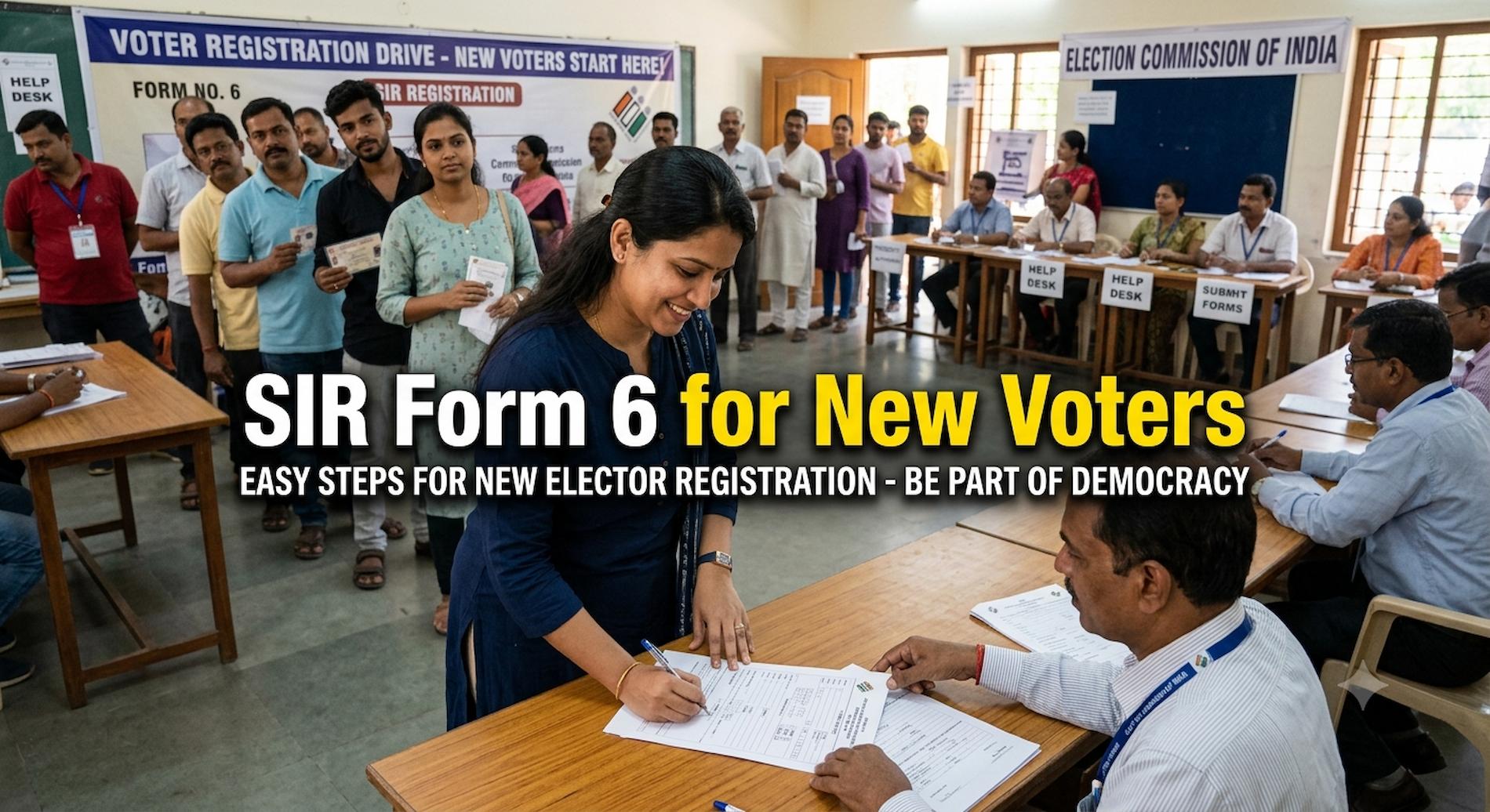
Form 6, new voters use is the statutory application for inclusion in the electoral roll. It is prescribed under the Registration of Electors Rules, 1960. The standard application asks for information such as the applicant’s personal details, date of birth, address, photograph and supporting documentation.
The Election Commission Form 6 is therefore central to India’s voter-enrolment system. The official voter-services portal currently describes Form 6 as the route for people who are 18 or above, or who will turn 18 within the applicable period, to seek new voter registration.
Normally, the concept is straightforward: an eligible citizen submits an application for inclusion in the electoral roll for the constituency where the person ordinarily resides.
The controversy arose because an additional SIR-related question appeared within the online process.
What Changed in July 2026?
In July, the ECINET version of Form 6 was modified to include a new declaration connected with Special Intensive Revision.
Applicants were asked to indicate whether:
- Their own name appeared in the electoral roll during the relevant previous SIR.
- A parent’s or grandparent’s name appeared in that roll.
- Neither their own name nor that of their parents appeared in the earlier roll.
The Indian Express reported that the online process sought detailed historical information, including polling booth and elector serial-number details from the earlier SIR roll.
Importantly, applicants could not complete the online application without responding to the additional question, according to the reports.
That created a practical question for first-time voters India: what happens when an 18-year-old has no personal entry in an old electoral roll and cannot easily locate the records of parents or grandparents?
Why Historic Voter Records Became Important
Families move. Addresses change. Electoral constituencies are reorganized, and old documents may not be readily available.
For young applicants, the challenge could therefore involve more than proving their current age and residence. Critics cited in media reports questioned whether families, particularly migrants and people who had moved between states, would always have access to historical electoral-roll information.
The ECI, however, has said the additional information helps map electors and can reduce the need for other documentation in the SIR process.
Why Did Election Commissioners Object?
The internal dispute is a major part of the SIR controversy.
According to The Indian Express, Election Commissioners Vivek Joshi and Sukhbir Singh Sandhu formally objected to the change and described it as unauthorized. Their reported concern was procedural: because Form 6 is prescribed under the Registration of Electors Rules, 1960, altering its statutory requirements should follow the legally prescribed rule-making process rather than simply changing the online interface.
Reports said the objections were raised in May 2026, before the additional declaration appeared online in July.
This does not mean a court has ruled that the additional declaration was unlawful. The legal characterization came from the reported objections of the two Election Commissioners and subsequent media reporting.
What Is the Legal Question?
The debate also touches Section 28 of the Representation of the People Act, 1950.
As reported by NDTV, the argument raised by the dissenting Election Commissioners was that rules concerning electoral registration are framed through the statutory rule-making mechanism, with amendments requiring the appropriate government process, Gazette notification and parliamentary laying requirements.
This is an important distinction. The dispute was not simply about whether the ECI could collect additional information. It also concerned how such a requirement could legally be introduced alongside a form prescribed under existing rules.
That reported interpretation should not be confused with a judicial determination. The issue was part of an internal Election Commission disagreement and subsequent public debate.
What Did the Election Commission Say?
The Commission’s position is different.
On September 24, the ECI said there had been “no change” to the statutory Form 6. Instead, it described the SIR material as an additional declaration or annexure associated with the revision exercise. The Commission also said differences among Election Commissioners were part of its internal decision-making process.
The distinction between the statutory form and the supplementary declaration is central to understanding the Election Commission of India response.
The official voter portal also currently separates new voter registration through Form 6 from SIR-related services, including the option to search the last SIR and fill an additional declaration where applicable.
The 2.37 Crore Young Voter Figure
One of the strongest numbers in the SIR news 2026 debate is the reported addition of 2.37 crore electors aged 18 to 28 since SIR began in Bihar in June 2025.
Election Commission officials cited by PTI and Hindustan Times said the figure represented young electors added to the rolls across India during the period. The same reporting said there were approximately 17.38 crore electors in the 18-to-28 age bracket at the time.
The figure provides useful context. The SIR-related registration procedure affects a large population of young citizens entering the electoral system, not merely a small group of applicants.
The ECI has also argued that the additional declaration assists voter mapping and can reduce documentary requirements in the appropriate circumstances.
Bihar SIR 2026: Where the Process Began
Bihar SIR 2026 is important because the nationwide debate over the procedure grew from the SIR exercise launched there in June 2025.
The broader exercise seeks to verify and revise electoral rolls using historical records and the prescribed claims and objections process. The Bihar experience subsequently became relevant to other states where SIR was introduced.
NDTV reported that approximately 13 crore names had been removed from draft electoral rolls across states and Union Territories during the broader ongoing SIR process. That figure should be understood as NDTV’s reported cumulative figure for the wider exercise, not as a finding that all those people were permanently barred from voting.
Other reporting has cited different totals depending on the states, stages and definitions included in the count. This is why figures concerning SIR electoral rolls should always be read with their specific time period and methodology.
The Issue of Previously Registered Voters
One particularly important procedural concern involves people whose names were removed during SIR and who later seek inclusion again.
NDTV reported concerns about the wording of the Form 6 declaration, which describes the applicant as seeking inclusion in the electoral roll for the first time. A person whose name previously appeared on an electoral roll but was removed during the revision process is not literally a first-time voter.
This has generated a voter deletion controversy over how such applicants should seek re-inclusion.
The issue should be described carefully. Reporting has raised the procedural and legal concern, but it does not establish that every deleted elector was required to make a knowingly false declaration. The circumstances of individual applications can differ.
What Voters Should Understand
- Form 6 remains the standard application for new voter enrolment.
- SIR-related declarations were an additional requirement during the relevant revision process.
- Historical electoral-roll information may be relevant to SIR mapping.
- Applicants should rely on instructions applicable to their state or UT and the current ECI portal.
- A draft-roll exclusion is not automatically the same as a permanent loss of eligibility.
September 26 Decision and September 30 Change
The September 26 decision is central to the latest SIR latest update.
According to reports, the full Commission decided that the additional declaration would apply during the SIR exercise rather than as a permanent part of the voter-registration procedure.
On September 30, the ECI implemented that distinction. The additional declaration was removed from ECINET in states and UTs where SIR had been completed. It remained available where SIR was still underway.
In states where SIR has concluded, applicants therefore return to the statutory Form 6 process prescribed under the Registration of Electors Rules, 1960.
This latest administrative step is the most significant development in the SIR row 2026 so far because it directly changes what applicants see on the online portal.
Political Parties and the Wider Debate
The dispute has become part of a broader political argument involving opposition parties, the ruling establishment and the Election Commission.
The Indian National Congress and other opposition political parties have raised concerns about SIR, voter deletions and the effect of additional documentation on eligible electors. At the same time, the Election Commission has defended the revision process and provided explanations for its procedures.
The appropriate distinction is between a party’s political claim and an independently verified fact. The presence of disagreement does not itself establish that electoral rolls were improperly altered.
For readers tracking SIR news 2026, the key developments are therefore the administrative decisions, official statements, published electoral-roll data and the treatment of individual claims and objections.
Why the Issue Matters for First-Time Voters
For new voter registration India, the Form 6 controversy matters because the application is often the first formal interaction a young citizen has with the electoral system.
An 18-year-old applicant may have no personal historical electoral entry. Families may have relocated. Parents or grandparents may have lived in another state. Old polling-booth and serial-number information may also be difficult to locate.
That is why the distinction between the statutory form and the supplementary SIR declaration is important.
The latest change also means applicants should pay attention to whether SIR is active in their particular state or UT rather than assuming that the same online requirements apply everywhere.
Timeline of the Form 6 Row
- June 2025: SIR began in Bihar.
- May 2026: Election Commissioners reportedly raised objections to the Form 6-related change.
- July 12, 2026: The Indian Express reported the new online requirement.
- July 2026: The additional SIR declaration appeared in the ECINET Form 6 process.
- September 24: The ECI said the statutory Form 6 itself had not been changed.
- September 25: Officials reported 2.37 crore new electors aged 18 to 28 had been added since SIR began in Bihar.
- September 26: The full Commission reportedly decided that the declaration would apply only during SIR.
- September 30: The additional declaration was removed in states and UTs where SIR had been completed.
Conclusion
The dispute shows how a seemingly minor change in an online application can raise questions about statutory rules, historical electoral records, voter access and the administration of a nationwide revision exercise. The latest ECI decision has clarified that the additional declaration is tied to SIR rather than being a permanent component of the ordinary registration process.