EC Offers Second Chance to Voters in Seven States
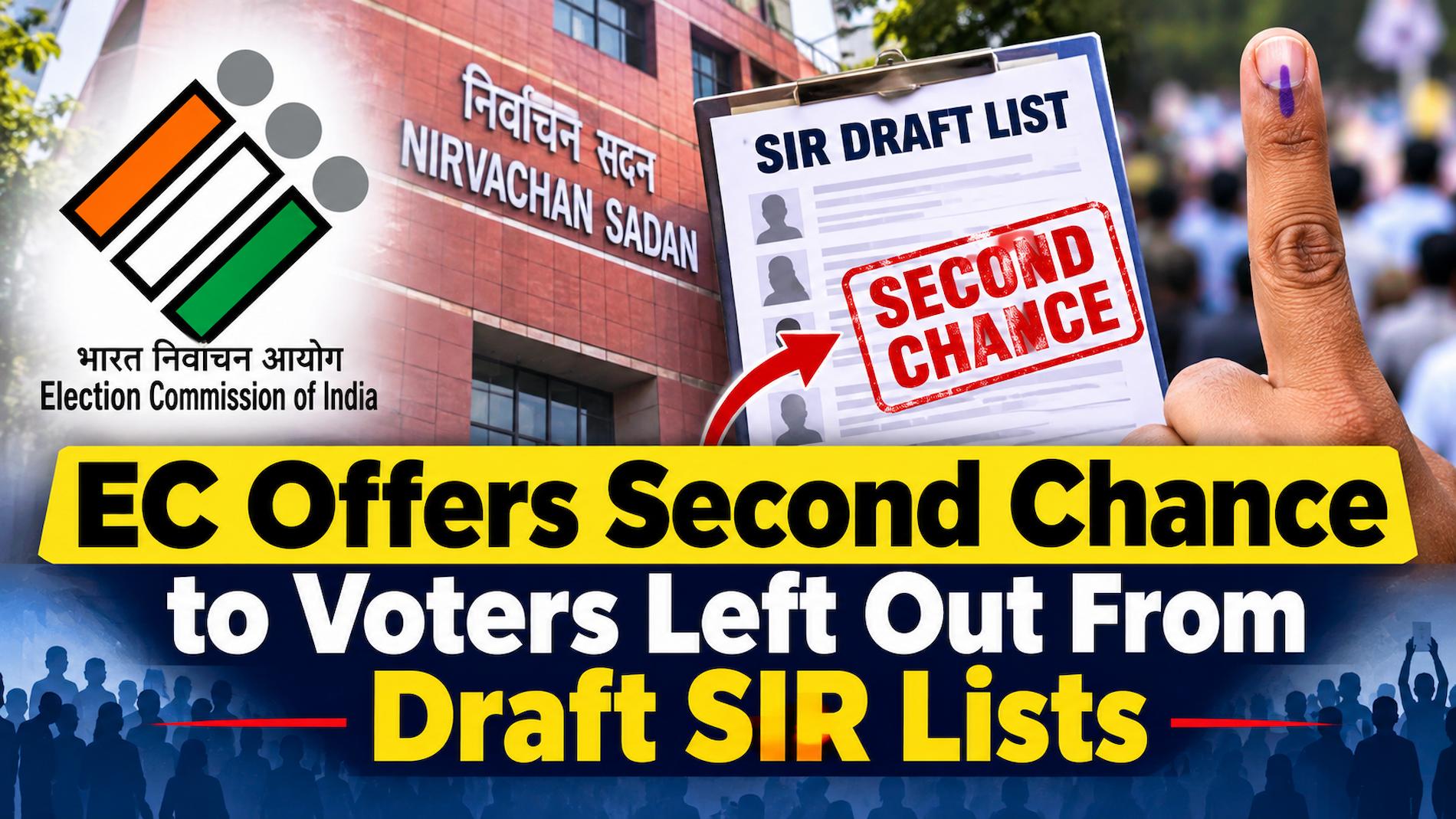
The Election Commission of India has announced another opportunity for voters excluded from draft electoral rolls during the Special Intensive Revision (SIR) in seven states and Union Territories. The November 6 decision introduces fresh enumeration forms for eligible electors, addressing concerns over missing names. Delhi accounts for approximately 47.5 lakh excluded voters, revising a major electoral issue.
The Election Commission of India (ECI) has announced a significant relief measure for eligible voters whose names were left out of draft electoral rolls during the ongoing Special Intensive Revision (SIR) exercise. On November 6, 2026, the Commission gave affected electors an additional opportunity across seven jurisdictions, including Delhi and six states.
The Second chance for voters in SIR rolls 2026 aims to help people whose enumeration forms were issued but not returned during the initial verification exercise. Under the revised procedure, eligible voters can submit fresh enumeration forms along with a declaration explaining why they could not return their original forms.
The seven jurisdictions covered are Delhi, Maharashtra, Haryana, Andhra Pradesh, Jharkhand, Telangana, and Nagaland. The announcement comes amid political disagreements over voter exclusions and Supreme Court questions about the procedure for restoring previously registered electors.
Key Takeaways
- November 6, 2026: The Election Commission announced an additional opportunity for eligible excluded voters across seven jurisdictions.
- Delhi draft electoral roll: Published on August 31, 2026, with 97,53,577 names against an earlier electorate of approximately 1.45 crore.
- 47,56,722 electors: Approximately 47.5 lakh voters were left out of the Delhi draft electoral roll.
- December 4, 2026: Revised date for publication of Delhi’s final electoral roll.
- November 30, 2026: Scheduled final-roll publication for Maharashtra, Haryana, Andhra Pradesh, Telangana, and Nagaland, with the same date for Jharkhand following disposal of claims and objections by November 23.
- ASDD categories: The additional opportunity covers eligible electors classified as Absent, Shifted, Dead, or Duplicate during the enumeration exercise.
EC Offers Second Chance to Voters in Seven States
The EC offers a second chance to Voters whose enumeration forms were distributed but not submitted during the initial Special Intensive Revision process.
The decision covers one Union Territory and six states, making it an important development in the preparation of electoral rolls ahead of future elections.
Which States and Union Territories Are Covered?
| Jurisdiction | Final Roll Schedule |
|---|---|
| Delhi | December 4, 2026 |
| Maharashtra SIR voter list | November 30, 2026 |
| Haryana electoral roll revision | November 30, 2026 |
| Andhra Pradesh SIR | November 30, 2026 |
| Telangana electoral rolls | November 30, 2026 |
| Nagaland SIR revision | November 30, 2026 |
| Jharkhand voter list | November 30, 2026 |
The Commission’s decision is particularly relevant for voters left out of SIR because their enumeration forms were not received or processed during the initial exercise.
Why Were Voters Excluded?
The affected electors fall under four categories commonly identified as ASDD:
- Absent: Voters who could not be contacted during the enumeration process.
- Shifted: Electors who had moved away from their registered addresses.
- Dead: Voters recorded as deceased.
- Duplicate: Electors identified as having duplicate entries.
These classifications were used during the revision process to identify records requiring further verification. However, being placed in one of these categories does not automatically establish that a person is ineligible to vote.
The additional opportunity allows eligible individuals to establish their details and seek inclusion before the final electoral rolls are published.
How Can Excluded Voters Get Their Names Back?
The November 6 instructions provide a fresh enumeration-form route for eligible electors who could not submit their original forms.
This is important because the process differs from the conventional approach of applying for new voter registration.
Step-by-Step Application Process
1. Obtain Fresh SIR Forms
Election officials will generate fresh, partially completed SIR forms for eligible excluded electors.
2. Submit the Required Declaration
Applicants must provide a declaration explaining why they could not submit their original enumeration forms.
3. Provide Updated Address Details
Voters who have shifted within the same state or Union Territory must provide their new residential address, Assembly constituency details, and supporting address proof.
4. Submit the Application Online or Offline
Applications can be submitted physically or through the election authorities’ online facilities, following the prescribed procedure. Eligible voters can check the availability of online SIR forms and related services through official election websites.
5. Complete Official Verification
The Electoral Registration Officer (ERO) will examine the application and supporting information before deciding on inclusion.
What About Homeless Voters?
The revised procedure also addresses the situation of homeless electors who may not possess conventional residential documents.
A Booth Level Officer’s (BLO) field verification report can be accepted as residence proof where the applicant has no address documents.
This provision is important because the absence of conventional paperwork should not automatically prevent an otherwise eligible elector from seeking inclusion.
Fresh Enumeration Forms vs. Form 6
One of the important developments in the SIR process concerns the use of Form 6.
On November 3, the ECI clarified that previously registered voters whose names were missing from draft electoral rolls could apply through Form 6. However, concerns emerged regarding the declaration associated with this form, particularly because it refers to first-time voter enrollment.
Following further developments, the Commission introduced an additional route through fresh enumeration forms on November 6.
| Application Method | Purpose |
|---|---|
| Fresh enumeration form | Additional route for eligible ASDD electors |
| Form 6 | Application for inclusion in the electoral roll |
| Form 8 | Application for correction or shifting of residence, as applicable |
| Form 7 | Application concerning objection to inclusion or deletion |
Eligible ASDD electors can use the fresh enumeration-form procedure instead of being required to apply through Form 6.
Those who have already submitted Form 6 do not need to submit another enumeration form or declaration under this additional procedure.
Accepted applicants will retain their existing Elector Photo Identity Card (EPIC) numbers.
The Second chance for voters in SIR rolls 2026 therefore represents an additional administrative route for eligible electors, rather than an entirely new voter registration exercise.
Can Voters Apply Through SIR Form Online?
Voters should first confirm their eligibility for the additional enumeration-form procedure with their local BLO or ERO. They can also check official election authority websites for available SIR form online facilities and submission instructions.
Applicants should keep their existing EPIC numbers and relevant address information available. They should use only official government facilities when submitting personal electoral information.
Delhi Draft Electoral Roll: 47.5 Lakh Names Missing
Delhi has emerged as a major focus of the SIR exercise because of the substantial difference between its earlier electorate and the published draft electoral roll.
The draft list was published on August 31, 2026, with 97,53,577 electors compared with an earlier electorate of approximately 1.45 crore.
Important Delhi SIR Figures
| Particulars | Reported Figures |
|---|---|
| Electorate before SIR | 1.45 crore |
| Names in draft roll | 97,53,577 |
| Electors left out | 47,56,722 |
| Notices issued for mapping discrepancies | 33,14,032 |
| Notices addressed by October 27 | 31,26,576 |
| Notices addressed | 94.34% |
| Form 6 applications | 2,75,856 |
| Form 8 applications | 1,03,352 |
| Form 7 applications | 21,603 |
| Final roll publication | December 4, 2026 |
These figures represent different categories of electors and applications. The 47,56,722 voters excluded from the draft roll should not be confused with electors who remained on the draft list but received notices concerning mapping or logical discrepancies.
The figures also relate specifically to Delhi. They should not be presented as the combined number of excluded electors across all seven jurisdictions.
What Happens to Delhi Voters?
The Delhi voter list revision process will continue through the prescribed claims and objections procedures before the final list is published.
Eligible electors who find their names missing should check the relevant electoral records and contact their BLO or ERO for guidance on the applicable application route. The excluded voters in Delhi should pay particular attention to the additional opportunity announced by the Commission.
Supreme Court Observations and Political Reactions
The additional opportunity follows concerns raised during the legal debate over the SIR procedure.
On October 28, 2026, the Supreme Court questioned why previously enrolled voters whose names were missing from draft rolls should have to apply through Form 6.
The Court’s observations highlighted the need for an appropriate mechanism to restore eligible voters through the enumeration process or Form 8.
The ECI’s November 6 decision subsequently provided an additional administrative route. However, the Court’s observations and the Commission’s order are separate developments and should not be treated as identical directions.
Congress Calls It a U-Turn
The Indian National Congress criticized the Commission’s earlier procedure and described the additional opportunity as a U-turn.
The party characterized the decision as a belated acknowledgment of concerns over wrongful deletion and exclusion. Congress also reiterated its demand for Chief Election Commissioner Gyanesh Kumar’s resignation or removal and called for the SIR exercise to be scrapped.
These remain the party’s political demands and allegations, rather than established judicial findings.
BJP Defends the Revision Exercise
The BJP has defended the SIR exercise amid opposition criticism. Its response has included criticism of the Opposition’s objections to the electoral revision process.
The ECI, meanwhile, has maintained its focus on completing the revision exercise and facilitating applications from eligible electors.
ECI Directs BLOs to Contact Excluded Voters
The Commission has instructed Chief Electoral Officers, District Election Officers, Electoral Registration Officers, and Booth Level Officers to take active steps to reach affected voters.
The instructions emphasize direct communication and greater transparency at the local level.
Important Instructions for Election Officials
- Conduct door-to-door visits to contact eligible excluded electors.
- Distribute fresh enumeration forms and explain the submission procedure.
- Contact voters through WhatsApp, email, SMS, and telephone.
- Coordinate with political parties’ Booth Level Agents, families, neighbors, and Resident Welfare Associations.
- Display booth-wise lists of excluded electors and probable reasons for exclusion at polling stations and government offices.
- Upload relevant lists on the websites of the respective Chief Electoral Officers.
- Publicize the additional opportunity through newspapers, social media, official websites, and public announcements.
- Monitor applications to ensure eligible voters receive an opportunity to seek inclusion.
Applications will be scrutinized by Electoral Registration Officers under Rule 21(1) of the Registration of Electors Rules, 1960.
How Should Voters Check Their Names?
Electors concerned about missing entries should take the following steps:
- Check their names in the latest draft electoral roll through official election facilities.
- Contact their local Booth Level Officer to understand the reason for exclusion.
- Ask whether they qualify for the fresh enumeration-form procedure.
- Keep their existing EPIC number and relevant address documents available.
- Submit the required form and declaration through the prescribed physical or online channel.
- Follow up with the Electoral Registration Officer regarding the application’s status.
Voters should rely on official Election Commission facilities and avoid sharing personal voter information with unofficial websites or agents.
Revised Electoral Roll Schedule
The November 6 announcement provides additional time for eligible electors to seek inclusion before the publication of final rolls.
For Delhi, the final electoral roll is scheduled for December 4, 2026. Maharashtra, Haryana, Andhra Pradesh, Telangana, and Nagaland have November 30 as their scheduled publication date. Jharkhand is also scheduled to publish its final roll on November 30, following disposal of claims and objections by November 23.
A Fair Chance to Be Counted
The additional opportunity gives eligible electors another chance to establish their details before the final lists are published. Its effectiveness will depend on how efficiently local election officials reach affected households, explain the procedure, and process applications. Political disagreements over the revision are likely to continue, but the immediate priority is clear: ensuring that every eligible citizen has a fair opportunity to participate in the electoral process without unnecessary procedural barriers.