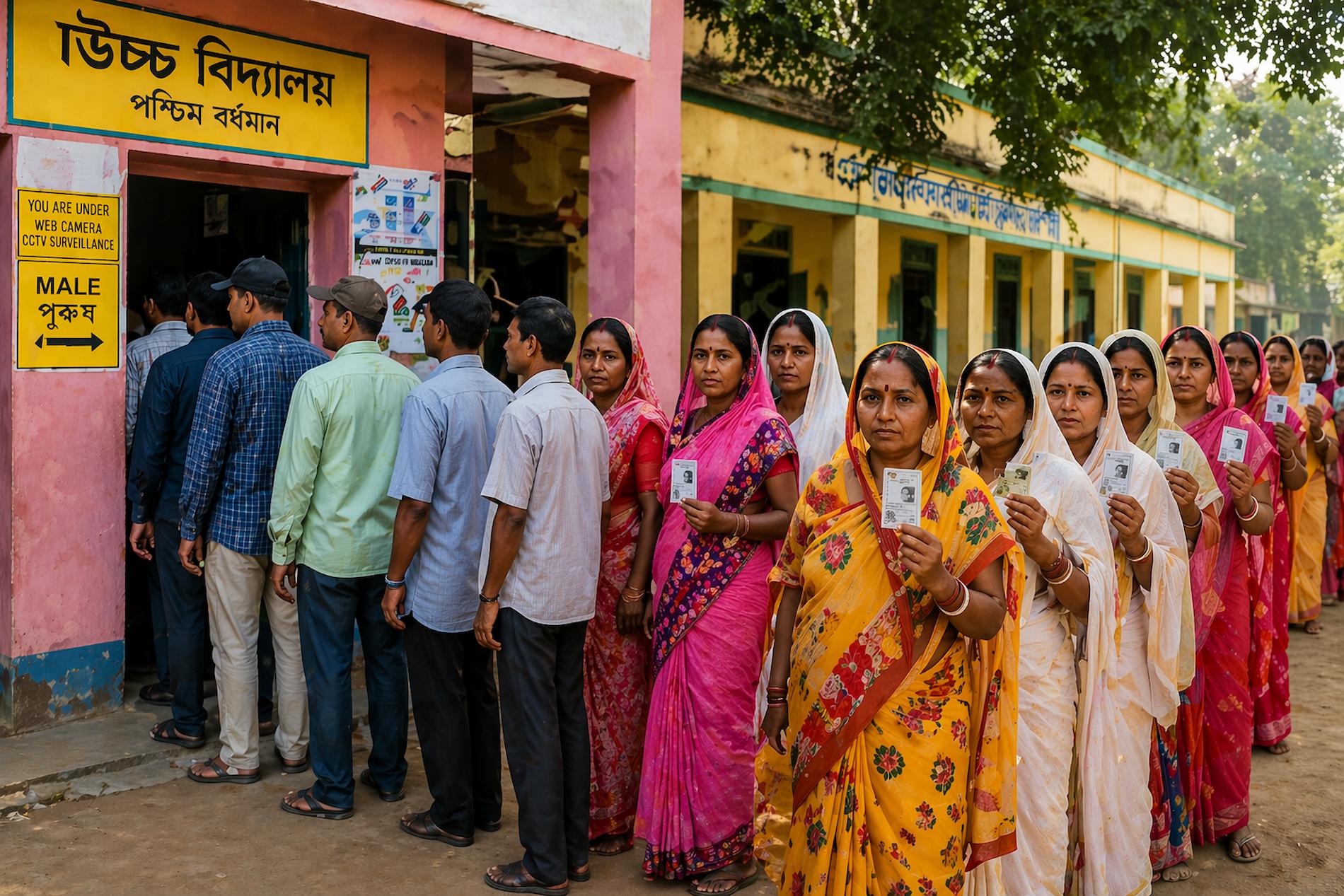
The West Bengal Assembly Election 2026 began with an extraordinary surge in voter participation, as phase one polling on 23 April 2026 recorded over 92 percent turnout. This marks one of the highest voting percentages in the state’s electoral history. From remote villages to bustling urban pockets, voters queued early and remained engaged throughout the day. Despite scattered incidents of violence, officials described the process as largely peaceful. The high turnout reflects strong political awareness and intense competition between major parties, making this election a crucial test of public sentiment.
An Overview
The 2026 Bengal Assembly Election has opened with a remarkable display of democratic participation, as phase one polling held on 23 April 2026 recorded a historic voter turnout exceeding 92 percent. According to the Election Commission of India, voting took place across 152 constituencies in 16 districts, including Darjeeling, Jalpaiguri, Cooch Behar, Murshidabad, and Birbhum. This turnout is the highest recorded in the state since 2011, surpassing previous election benchmarks. The election is being conducted in two phases, with the next round scheduled for 29 April 2026 and counting set for 4 May 2026. The strong voter response highlights the significance of this contest, especially amid intense competition between the All India Trinamool Congress and the Bharatiya Janata Party.
Key Takeaways
- Phase one polling recorded over 92 percent voter turnout across 152 constituencies.
- Voting took place on 23 April 2026 in 16 districts.
- Around 3.6 crore voters were eligible in this phase.
- Elections are being conducted in two phases, with the second phase on 29 April.
- The vote count will be held on 4 May 2026.
- Security forces and EVMs ensured smooth polling despite isolated violence.
West Bengal Phase One Voting: Record Turnout
The West Bengal phase one voting has set a new benchmark for electoral participation, with turnout ranging from 92.59 percent to 92.72 percent. This remarkable surge in the Bengal election percentage 2026 reflects heightened voter awareness and enthusiasm across the state. In comparison, the 2011 Assembly elections recorded a turnout of 85.55 percent, while the 2024 Lok Sabha elections saw approximately 79.8 percent participation. With nearly 3.6 crore eligible voters in phase one, the voter turnout West Bengal 2026 signals a decisive moment in the state’s political landscape and underscores the growing importance of civic engagement in democratic processes.
Strong Participation Across Rural and Urban Areas
The Bengal voter participation 2026, trends reveal widespread engagement across rural and semi-urban regions. Early reports indicated that nearly 41 percent of the vote was cast by 11 AM, suggesting a strong start to polling day. The rural Bengal voter turnout was particularly notable, with long queues forming in villages from early morning. This pattern reflects sustained grassroots mobilization by political parties and increasing political awareness among voters. Additionally, several constituencies reported higher participation among women voters than among men, indicating a positive shift toward more inclusive electoral participation and the growing empowerment of female voters in the political process.
Extensive Security and Election Management
The authorities implemented robust election security measures in Bengal to ensure a smooth and fair voting process. More than 2,450 companies of the central armed police forces, totaling approximately 2.5 lakh personnel, were deployed across the state. Over 80,000 polling stations were established, with more than 8,000 categorized as “super sensitive” and provided with enhanced security arrangements. The use of Electronic Voting Machines with VVPAT, combined with webcasting and surveillance systems, ensured transparency and accountability throughout the process. These arrangements played a crucial role in managing such a large-scale election and maintaining order during polling.
Isolated Violence Amid Largely Peaceful Polling
Despite the high turnout, Bengal election violence news highlighted sporadic incidents across several districts. Reports from Birbhum mentioned stone-pelting on security personnel, while Murshidabad witnessed clashes between rival political workers. In parts of Dinajpur and Kumarganj, allegations of assault on candidates surfaced, and incidents of vehicle vandalism were reported from select constituencies. Overall, more than 400 complaints were registered with election authorities during the polling process. However, officials maintained that these incidents were isolated and did not significantly disrupt the overall voting process, which remained largely peaceful and orderly.
Election Commission’s Oversight
The Election Commission of Bengal ensured close monitoring of the election through observers and rapid response teams deployed across districts. Officials emphasized that polling was conducted smoothly, with prompt action taken in response to complaints and violations. The Commission’s proactive approach, combined with technological monitoring tools, helped maintain transparency and efficiency. The Election Commission of India played a crucial role in upholding the integrity of the electoral process during such a high-stakes election.
Political Reactions and Narratives
The record turnout triggered strong reactions from political leaders. Mamata Banerjee stated that the high voter participation reflected public response to recent voter list changes and growing political awareness. The Bharatiya Janata Party raised concerns over alleged voter intimidation and demanded stricter enforcement of election rules. Meanwhile, the All India Trinamool Congress highlighted the turnout as evidence of public support and democratic enthusiasm. The overall narrative across parties suggests that high turnout is being interpreted as a strong signal of voter intent and political momentum.
Additional Key Highlights from Phase One Polling
- Phase one polling covered strategically sensitive border districts, making security deployment and monitoring critically important across regions.
- High participation from first-time voters indicated growing youth engagement and increased political awareness among new electors.
- Special arrangements supported senior citizens and differently-abled voters, including priority queues, assistance booths, and accessibility facilities at polling stations.
- The Election Commission of India deployed micro-observers, flying squads, and webcasting systems to ensure transparency and curb malpractice.
- Favorable weather conditions helped maintain steady voter turnout throughout the day, with no major disruptions across districts.
- Political parties intensified booth-level mobilization and grassroots campaigns, which contributed significantly to the high voter turnout.
- Efficient coordination between local administration and security forces ensured a quick response to incidents and the smooth conduct of polling.
SIR Voter List and Electoral Concerns
The election follows the controversial SIR voter list revision process in Bengal, which involved updating and correcting electoral rolls. Opposition parties expressed concerns over alleged large-scale deletions and inaccuracies, raising fears of voter exclusion. The issue of voter list revision became a central topic during election campaigns and influenced public discourse. While authorities maintained that the process was necessary for accuracy, the debate around voter inclusion added another layer of complexity to the election environment.
Key Battlegrounds and Political Stakes
The Bengal assembly election 2026 features several high-stakes constituencies, particularly in North Bengal and border regions. Areas such as Cooch Behar, Jalpaiguri, and Siliguri have emerged as critical battlegrounds due to their strategic importance. The election is widely seen as a direct contest between the TMC and the BJP in Bengal, with both parties investing significant resources in campaigning. Smaller parties and alliances are also expected to influence outcomes in closely contested seats, further intensifying the election’s competitiveness.
Broader Political Implications
The record voter turnout in India’s elections reflects a strengthening of democratic engagement in the country. The West Bengal Assembly Election 2026 is being viewed as a crucial political event with implications beyond the state. Analysts consider it a precursor to the 2029 Lok Sabha elections, as it will shape national political narratives and strategies. The results will influence the BJP’s expansion plans in eastern India and the Trinamool Congress’s national ambitions, making this election a significant milestone in India’s political landscape.
Conclusion
The West Bengal Assembly Election 2026 has begun with an unprecedented level of voter enthusiasm and participation. The historic turnout in phase one underscores the importance of the election and the active role of citizens in shaping governance. Despite isolated incidents of violence, the process has largely remained peaceful, reflecting the resilience of democratic institutions. As the state moves toward the second phase of polling, the momentum generated by this record turnout is expected to continue, setting the stage for a decisive electoral outcome on 4 May 2026.