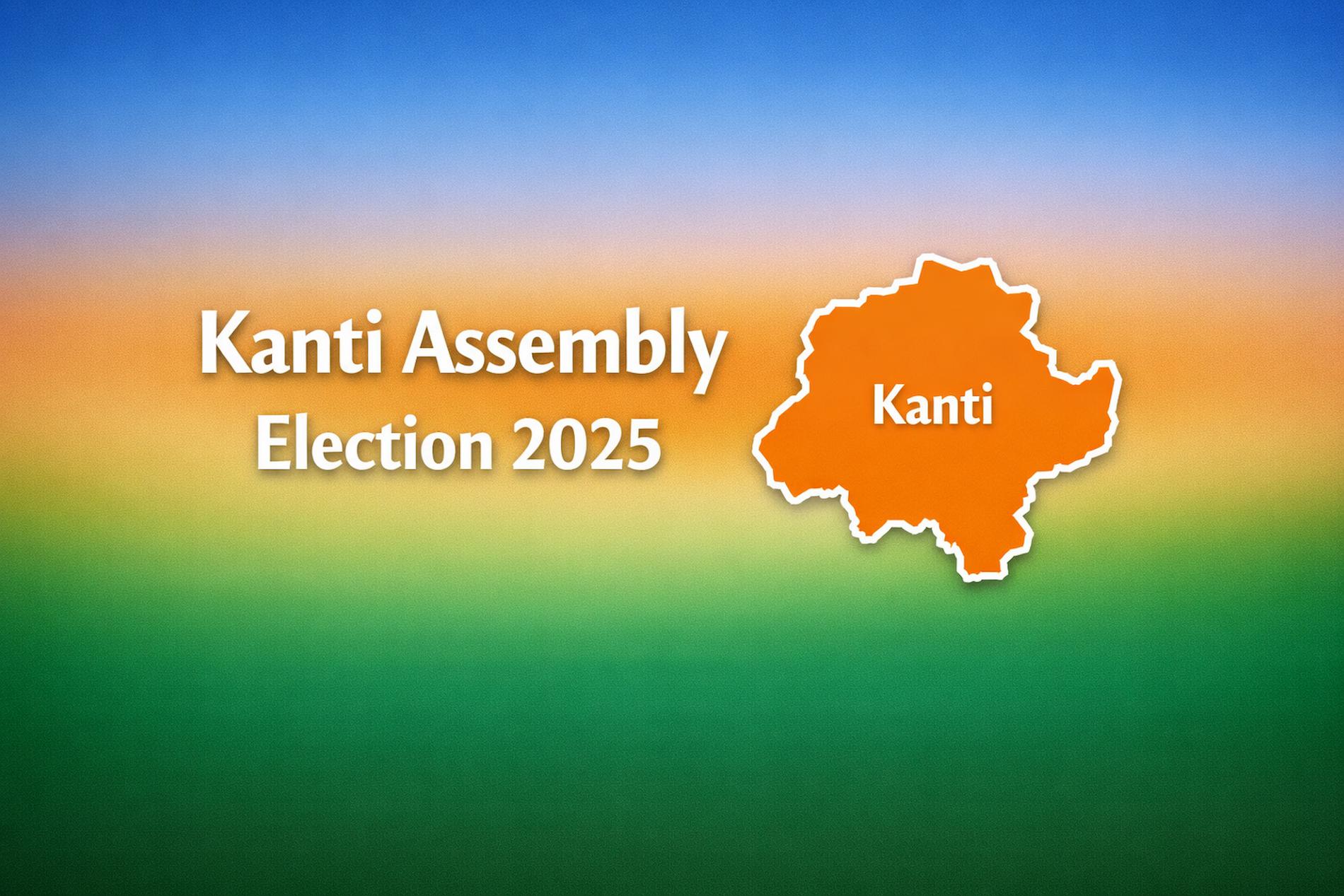
Kanti Assembly Constituency (Vidhan Sabha) (Constituency No. 95), Bihar
Kanti Assembly constituency, located in Muzaffarpur district of north Bihar, is a politically active region known for its agricultural productivity, industrial presence, and proximity to the urban centre of Muzaffarpur. Over the years, Kanti has evolved into a constituency where rural farming communities coexist with emerging industrial and service-sector activities. Its political landscape reflects broader Political trends in Bihar, where development concerns, caste alignments, and leadership credibility together influence electoral outcomes.
With increasing political engagement and demographic change, the constituency is expected to attract attention in the Bihar Assembly elections 2025, as parties and candidates prepare for another competitive electoral cycle.
Bihar Assembly Elections 2025
Kanti Assembly Election 2025 – Voting Date
Voting for the Bihar assembly elections 2025 for this constituency was completed on 11 November 2025, as part of Phase 2 of the 2025 Bihar Legislative Assembly election.
Kanti Assembly Election Result 2025
AJIT KUMAR of the Janata Dal (United) won by 117,299 votes in the Kanti seat in the 2025 Bihar Vidhan Sabha elections.
The counting of votes and declaration of results for the 2025 Bihar Assembly elections were completed on November 14, 2025.
Candidates List: Kanti Assembly Election 2025
| S.N. | Candidate | Party | EVM Votes | Postal Votes | Total Votes | % of Votes |
|---|---|---|---|---|---|---|
| 1 | AJIT KUMAR | Janata Dal (United) | 116893 | 406 | 117299 | 50.43 |
| 2 | MOHAMMAD ISRAIL MANSURI | Rashtriya Janata Dal | 91136 | 368 | 91504 | 39.34 |
| 3 | VIVEK KUMAR | Bahujan Samaj Party | 1197 | 3 | 1200 | 0.52 |
| 4 | ANAND KUMAR JHA | Lok Chetna Dal | 387 | 0 | 387 | 0.17 |
| 5 | KUMARI SHEETAL | Aazad Samaj Party (Kanshi Ram) | 2584 | 10 | 2594 | 1.12 |
| 6 | PRANJAL PRAKALP | Kisan Suraj Dal | 345 | 2 | 347 | 0.15 |
| 7 | LAL BABU ROY | Socialist Unity Centre Of India (COMMUNIST) | 1194 | 3 | 1197 | 0.51 |
| 8 | BIRENDRA KUMAR | Rashtriya Jansambhavna Party | 588 | 1 | 589 | 0.25 |
| 9 | SUDARSHAN MISHRA | Jan Suraaj Party | 4209 | 42 | 4251 | 1.83 |
| 10 | AJIT KUMAR | Independent | 748 | 3 | 751 | 0.32 |
| 11 | MD JAFRUDIN | Independent | 532 | 0 | 532 | 0.23 |
| 12 | RANJIT KUMAR JHA ALIAS PINAKI JHA | Independent | 1236 | 1 | 1237 | 0.53 |
| 13 | SURESH KUMAR GUPTA | Independent | 2888 | 1 | 2889 | 1.24 |
| 14 | NOTA | None of the Above | 7819 | 4 | 7823 | 3.36 |
| Total | 231756 | 844 | 232600 |
1. Foundational Details
- District: Muzaffarpur
- Lok Sabha Constituency: Muzaffarpur
- Constituency Number: 95
- Seat Type: General (Unreserved)
- Total Electors (2020): Approximately 3.20 lakh
- Voter Turnout (2020): Around 57%
Geography and Administrative Divisions
Kanti Assembly constituency lies to the west of Muzaffarpur city and comprises the Kanti Community Development Block along with adjoining rural panchayats. The region is characterised by fertile alluvial plains shaped by tributaries of the Burhi Gandak River. These conditions support intensive agriculture but also expose the area to seasonal flooding and waterlogging.
The constituency enjoys relatively strong connectivity through the Muzaffarpur–Motihari highway and regional railway routes, linking it with major trade centres across north Bihar. Kanti is also known for the Kanti Thermal Power Station, one of the district’s major industrial installations, which contributes to the local economy and employment.
Economic Base
Kanti’s economy is a combination of agriculture, industry, and services. Major crops include paddy, wheat, maize, and vegetables cultivated on fertile farmland. The presence of the thermal power plant and nearby urban markets has encouraged growth in small businesses, transport services, and construction.
Migration remains an important factor in household income, with many workers travelling to metropolitan cities for employment. Despite these changes, agriculture and allied sectors continue to dominate the livelihood structure of the constituency.
2. Electoral History and Political Background
Kanti has historically been a politically competitive seat, with multiple parties, including the Rashtriya Janata Dal (RJD), Bharatiya Janata Party (BJP), and Janata Dal (United) competing for influence. The constituency’s electoral outcomes often mirror broader political developments in Bihar, where alliances and local leadership shape voting patterns.
Recent Election Results
| Year | Winning Candidate | Party | Runner-Up | Party | Margin (Votes) | Turnout (%) |
|---|---|---|---|---|---|---|
| 2020 | Mohammad Israil Mansuri | RJD | Ajit Kumar | JD(U) | 10,314 | 57.0 |
| 2015 | Ajit Kumar | JD(U) | Mohammad Israil Mansuri | RJD | 8,203 | 58.6 |
In the 2020 Bihar assembly election, the previous poll in the 2025 cycle, Mohammad Israil Mansuri of the RJD defeated JD(U)’s Ajit Kumar, reversing the result of the 2015 election. The close margins illustrate the constituency’s competitive nature and its role in shaping the political landscape in Bihar.
Historical Trends
Earlier elections saw alternating victories by the RJD and JD(U), reflecting a balance between agrarian communities and urban influences in the constituency. Alliances between national and regional parties have frequently reshaped electoral strategies.
The constituency has also produced several influential Politicians in Bihar, whose campaigns have focused on infrastructure, employment, and welfare delivery. As the next election approaches, observers closely watch Bihar election updates and local campaign developments for signals about voter sentiment.
3. Social and Economic Fabric
Demographic Composition
- Population: Around 4.3 lakh (projected from Census estimates).
- Urban–Rural Ratio: Nearly 80% rural and 20% semi-urban.
- Gender Ratio: Approximately 920 females per 1,000 males.
- Literacy Rate: Around 64 per cent.
Major Communities and Social Groups
Kanti’s electorate is socially diverse, with multiple caste groups that influence local politics.
- OBC Communities: Yadav, Kurmi, and Koeri groups form a significant part of the population.
- Extremely Backward Classes: Several artisan and service communities play a decisive role in elections.
- Upper Castes: The Brahmin and Rajput communities are mainly present in semi-urban areas.
- Minorities: Muslim communities contribute significantly to the constituency’s political balance.
- Scheduled Castes: Dalit communities are distributed across rural panchayats.
Livelihood and Occupations
Agriculture remains the backbone of the economy, supported by dairy farming and vegetable cultivation. Small retail trade, transport services, and employment linked to the power plant also contribute to income generation.
The growing youth population is increasingly vocal about education, skill development, and employment opportunities, themes that frequently appear in Political updates in Bihar and local debates.
4. Ground-Level Issues and Governance
Developmental Challenges
Several issues consistently influence voter priorities in Kanti:
- Flooding and Drainage: Seasonal flooding affects crops and rural roads.
- Employment Opportunities: Limited industrial expansion encourages youth migration.
- Infrastructure: Rural roads, electricity reliability, and irrigation facilities require improvement.
- Healthcare and Education: Local health centres and schools often face shortages of staff and infrastructure.
- Urban Expansion: Rapid growth around Muzaffarpur has created pressure on public services and transport systems.
Governance and Representation
Local governance efforts have focused on road development, electrification, and the implementation of welfare schemes under state and central programmes. Housing initiatives, drinking water projects, and rural electrification schemes have improved living conditions for many households.
Nevertheless, voters continue to demand stronger economic opportunities and better infrastructure. These expectations are likely to influence campaign narratives in the Upcoming elections in India, particularly in constituencies like Kanti that combine rural and semi-urban populations.
5. Political Actors and Party Dynamics
Kanti’s politics revolve around competition among major regional and national parties.
- RJD: Strong support among sections of OBC and minority voters.
- JD(U): Maintains a network among rural communities and development-focused voters.
- BJP: Benefits from urban and upper-caste support in nearby areas.
These alignments reflect the broader configuration of Bihar constituencies, where alliances and local leadership determine electoral outcomes. As the campaign environment evolves, observers closely monitor election news in Kanti and Kanti elections news 2025 for developments in candidate selection and party strategy.
6. Strategic Electoral Analysis
Kanti’s electoral behaviour reflects a combination of caste dynamics, development expectations, and candidate credibility. Rural voters often prioritize welfare delivery and agricultural support, while semi-urban residents focus on employment and infrastructure.
The constituency’s close contests make it a seat to watch during the Bihar election results 2025 cycle. Analysts expect intense competition as parties seek to consolidate diverse social groups and expand their organizational reach.
Campaign messaging typically highlights governance performance, economic growth, and youth opportunities. These themes are likely to dominate discussions around Political trends in Bihar as the next election approaches.
7. Forward-Looking Analysis
Kanti’s political future will depend on how effectively leaders address key issues such as infrastructure development, employment generation, and flood management. With an expanding population and rising educational aspirations, the electorate increasingly demands accountable governance and visible results.
The constituency’s outcome will contribute to the broader narrative surrounding the Bihar election 2025 results and the anticipated 2025 Bihar election results scenario. Analysts will also track the Kanti election results 2025 to assess shifts in voter behaviour across north Bihar.
As part of the wider electoral environment, the seat will remain a focal point in the Bihar election results 2025, reflecting how regional dynamics influence state-level politics.
FAQs About Kanti Assembly Constituency
What is the reservation status of the Kanti Assembly constituency?
Kanti is a General category seat without reservation for the Scheduled Castes or the Scheduled Tribes. The constituency includes diverse communities from rural and semi-urban areas within Muzaffarpur district.
Who is the current MLA of the Kanti constituency?
The current MLA is Mohammad Israil Mansuri of the Rashtriya Janata Dal, elected in the 2020 state election after defeating JD(U) candidate Ajit Kumar.
Which Lok Sabha constituency does Kanti belong to?
Kanti Assembly constituency falls under the Muzaffarpur Lok Sabha constituency, a key parliamentary seat in north Bihar.
What are the main issues affecting voters in Kanti?
The main concerns include flooding, limited employment opportunities, gaps in rural infrastructure, and access to quality healthcare and education.
What drives the economy of Kanti?
Agriculture, small-scale trade, and employment linked to the Kanti Thermal Power Station are the primary economic drivers in the constituency.
Why is Kanti considered an important constituency in Bihar politics?
Kanti represents a mix of rural and semi-urban voters, making it a barometer of political sentiment in Muzaffarpur district and nearby regions.