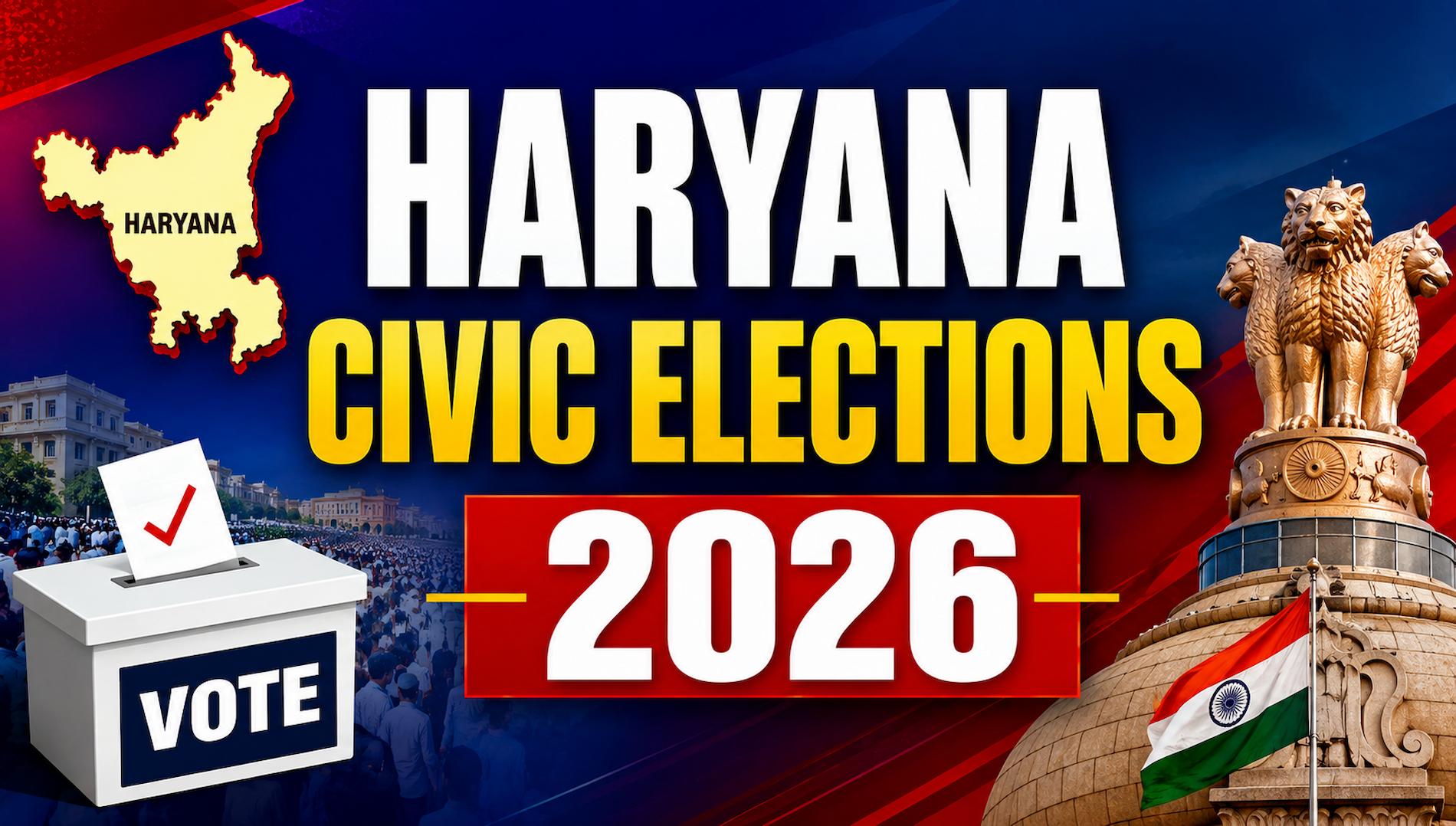
The Haryana Civic elections 2026 concluded peacefully on May 10 with over 54% voter turnout across key municipal corporations and councils. From Panchkula to Sonipat, urban voters cast ballots in a major local governance test. With the BJP and Congress locked in crucial contests, all eyes now shift to the May 13 counting.
Overview
The Haryana Civic elections 2026 marked a significant urban political exercise across multiple municipal corporations, councils, and local civic bodies, concluding on Sunday, May 10, 2026, under tight security and broad administrative oversight. Polling began at 8:00 AM and ended at 6:00 PM across 817 booths, covering approximately 8.73 lakh registered voters. Around 4.75 lakh voters participated, pushing turnout to roughly 54–54.5%. According to the Haryana State Election Commission, polling remained largely peaceful, fair, and transparent despite isolated allegations of bogus voting and duplicate entries. Major urban centres, including Ambala, Panchkula, and Sonipat, emerged as key battlegrounds between the BJP Bhartiya Janta Party and the Congress. With EVMs sealed in strong rooms and counting scheduled for May 13, these civic polls are widely viewed as an important political signal ahead of Haryana’s larger electoral contests.
Key Takeaways
- Polling date: May 10, 2026
- Polling hours: 8:00 AM to 6:00 PM
- Counting date: May 13, 2026
- Registered voters: 8.73 lakh
- Votes cast: Approximately 4.75 lakh
- Overall turnout: 54–54.5%
- Polling booths: 817
- Total candidates: Around 777
- Mayoral candidates: 29
- Municipal council/committee president candidates: 38
- Total posts decided: 528
- Major corporations: Ambala, Panchkula, Sonipat
- Highest turnout: Sampla (79.2–79.5%)
- Lowest turnout among corporations: Sonipat (48%)
Haryana Municipal Election 2026: Polling Day Timeline and Process
The Haryana municipal election 2026 was conducted in a single-day polling format on May 10.
Voting began promptly at 8:00 AM and continued until 6:00 PM. Across the state, district administrations coordinated booth management, security deployment, and EVM logistics.
After voting concluded, EVMs were moved to designated strong rooms under police protection, with strict surveillance ahead of May 13 counting.
Haryana Civic Polls 2026: Scope and Municipal Coverage
The Haryana civic polls 2026 covered seven civic bodies, including three major municipal corporations and multiple councils and committees.
Major Municipal Corporations
- Ambala Municipal Corporation
- Panchkula Municipal Corporation
- Sonipat Municipal Corporation
These elections also extended to local councils, committees, and Panchayati Raj positions, making this one of Haryana’s most politically significant local elections this year.
Panchkula Municipal Election and Urban Political Stakes
The Panchkula municipal election became one of the most watched contests due to allegations surrounding duplicate voter entries. Congress leaders raised concerns over 17,086 alleged duplicate voters.
Despite these accusations, the State Election Commission maintained polling integrity. Panchkula recorded approximately 53.4% turnout as compared to the elections in 2019.
This contest carries symbolic value because Panchkula is often viewed as a politically strategic urban center.
District-Wise Turnout: Where Voters Showed Up Most
Turnout varied significantly across districts.
Key Turnout Data
- Ambala: 54.3%
- Panchkula: 53.4%
- Sonipat: 48%
- Sampla (Rohtak): 79.2–79.5%
- Dharuhera: 72.4%
Sampla’s exceptionally high turnout highlighted intense grassroots engagement, while Sonipat’s lower participation raised questions about urban voter enthusiasm.
Bullet Point Section: Highest and Lowest Turnout Zones
- Sampla: Highest turnout
- Dharuhera: Strong participation
- Ambala: Moderate turnout
- Panchkula: Competitive turnout
- Sonipat: Lowest among key corporations
Haryana Municipal Corporation Voting: Candidates and Electoral Scale
The Haryana municipal corporation voting process involved approximately 777 candidates contesting 528 posts.
Candidate Breakdown
- 29 mayoral candidates
- 38 council/committee president candidates
- Hundreds of ward-level and local representatives
This broad candidate base reflects growing competition in local governance and municipal administration.
Political Parties and the Main Electoral Contest
Several major Political parties contested aggressively.
BJP
- Focused on governance continuity
- Sought urban dominance under Chief Minister Nayab Singh Saini
Congress
- Positioned itself around urban dissatisfaction
- Targeted governance gaps and civic complaints
Other Key Players
- JJP
- AAP
- Independents
At the ward level, independents remained especially relevant.
Haryana Elections News 2026: Major Campaign Issues
The Haryana elections news 2026 cycle centred heavily on urban governance.
Top Voter Concerns
- Water supply
- Road conditions
- Sanitation
- Local corruption
- Duplicate voter allegations
- Anti-incumbency sentiment
While the BJP pushed governance and continuity, Congress attempted to convert civic grievances into electoral momentum.
Bullet Point Section: Polling Day Challenges
- Bogus voting allegations in Panchkula
- Duplicate voter controversy
- Sonipat voting complaints
- Bribery accusations in Dharuhera
- Technical glitches at select booths
Despite these incidents, authorities maintained that disruptions were limited and manageable.
Haryana State Election Commission and Administrative Oversight
The Haryana State Election Commission, led by State Election Commissioner Devender Singh Kalyan, played a central role in ensuring procedural credibility.
Security included:
- Police deployment
- Videography
- Micro-observers
- MCC enforcement
Officials consistently emphasized fairness, transparency, and peaceful execution.
Local Body Elections Haryana: Why These Polls Matter
The local body elections in Haryana are more than municipal contests. They often shape political narratives ahead of larger Assembly and parliamentary battles.
A BJP win could reinforce municipal governance credibility. A Congress surge may signal urban dissatisfaction.
For this reason, civic polls are increasingly treated as political mood indicators.
Haryana Ward Election News: The Role of Independents
The Haryana ward election news also highlighted the influence of independents, especially in localized contests where neighborhood issues outweigh broader ideology.
Ward-level politics in Haryana often hinges on candidate familiarity, caste equations, and civic responsiveness rather than party alone.
Haryana Election Results May 13: What Comes Next?
The Haryana election results May 13 announcement will determine who controls key urban governance structures.
With strong rooms sealed and security tightened, the counting day is expected to be politically consequential.
Analysts will closely watch:
- BJP’s municipal hold
- Congress urban recovery
- Independent disruptions
- Civic governance narratives
Haryana Politics and Future Implications
Current Haryana politics suggests these elections may shape strategic planning for future state contests.
For the BJP, maintaining civic strength is crucial. For Congress, urban revival remains essential.
The results may influence broader campaign messaging, coalition strategies, and governance debates.
Conclusion
Haryana’s civic elections offered a meaningful snapshot of urban political sentiment, administrative credibility, and local governance priorities. With moderate turnout, competitive races, and district-level contrasts, these polls could significantly influence future political strategies across the state. The May 13 results will reveal whether governance continuity or urban dissatisfaction shaped Haryana’s latest democratic exercise.