Dhamdaha Assembly Constituency (Vidhan Sabha) (Constituency No. 61), Bihar
Dhamdaha Assembly constituency, located in the Purnia district of eastern Bihar, is a predominantly rural and agrarian seat shaped by flood-prone geography, migration-driven livelihoods, and strong grassroots politics. Situated in the Seemanchal region, Dhamdaha reflects the broader social and political complexities of eastern Bihar, where development deficits, caste dynamics, and welfare delivery strongly influence electoral behaviour. As Bihar moves toward the Bihar Assembly elections 2025, Dhamdaha is expected to remain a closely watched constituency within the wider landscape of Bihar constituencies.
Bihar Assembly Elections 2025
Dhamdaha Assembly Elections 2025 – Voting Date
Voting for the Dhamdaha assembly elections 2025 for this constituency was completed on 11 November 2025, as part of Phase 2 of the 2025 Bihar Legislative Assembly election.
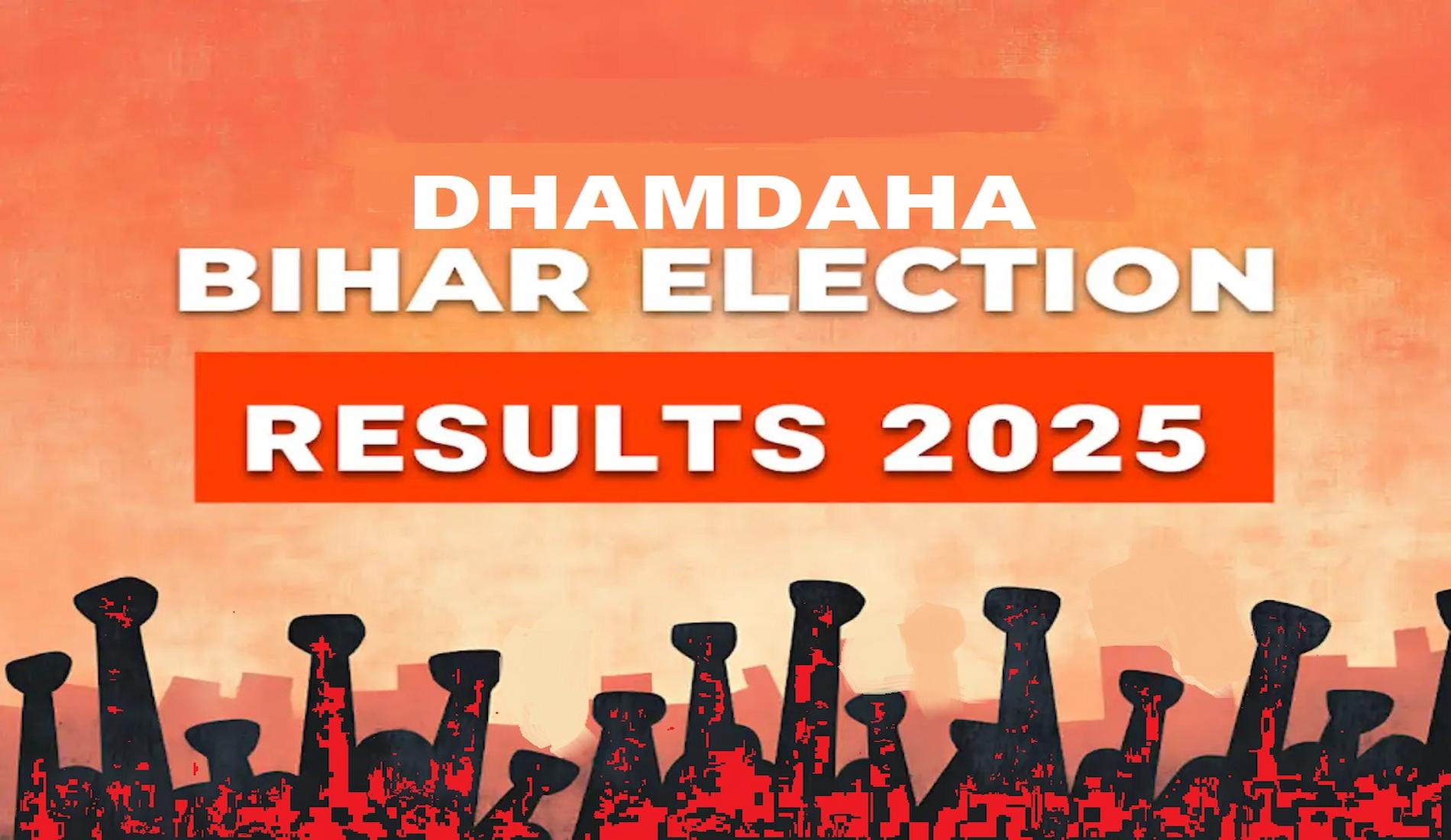
Dhamdaha Assembly Elections 2025 Results
Leshi Singh of JD(U) wins by 138750 votes in the Dhamdaha seat in the 2025 Bihar Vidhan Sabha elections.
The counting of votes and declaration of results for the 2025 Bihar Assembly elections were completed on November 14, 2025.
Candidates List: Dhamdaha Assembly Elections 2025
| S.N. | Candidate | Party | EVM Votes | Postal Votes | Total Votes | % of Votes |
|---|---|---|---|---|---|---|
| 1 | LESHI SINGH | Janata Dal (United) | 138613 | 137 | 138750 | 57.32 |
| 2 | SANTOSH KUMAR | Rashtriya Janata Dal | 83472 | 119 | 83591 | 34.53 |
| 3 | MOHD ISHTIYAQUE ALAM | All India Majlis-E-Ittehadul Muslimeen | 5123 | 3 | 5126 | 2.12 |
| 4 | BHAGWAN MAREYA | Rashtriya Jansambhavna Party | 417 | 0 | 417 | 0.17 |
| 5 | MANOJ SHARMA | Jagrook Janta Party | 248 | 1 | 249 | 0.1 |
| 6 | RAKESH KUMAR | Jan Suraaj Party | 1800 | 4 | 1804 | 0.75 |
| 7 | KUMARI KUMKUM RANI | Independent | 365 | 0 | 365 | 0.15 |
| 8 | CHAND LAL URANV | Independent | 578 | 3 | 581 | 0.24 |
| 9 | PRADIP YADAV | Independent | 447 | 0 | 447 | 0.18 |
| 10 | RAMAN KUMAR | Independent | 922 | 0 | 922 | 0.38 |
| 11 | VINDESHWARI SHARMA | Independent | 3032 | 0 | 3032 | 1.25 |
| 12 | NOTA | None of the Above | 6779 | 2 | 6781 | 2.8 |
| Total | 241796 | 269 | 242065 |
1. Foundational Details
- District: Purnia
- Lok Sabha Constituency: Purnia
- Constituency Number: 61
- Seat Type: General (Unreserved)
- Total Electors (2020): Approximately 3.25 lakh
- Voter Turnout (2020): Around 58%
Geography and Administrative Divisions
Dhamdaha lies in the eastern floodplains of Bihar and comprises Dhamdaha and Banmankhi border areas, along with several gram panchayats administered through block and panchayati raj institutions. The constituency is crisscrossed by rivers such as the Kosi and its distributaries, making the soil fertile but highly vulnerable to annual flooding.
Road connectivity links Dhamdaha to Purnia town and Banmankhi, though interior villages often remain cut off during the monsoon. The terrain is flat, low-lying, and humid, with agriculture forming the backbone of daily life.
Economic Base
The economy of Dhamdaha is largely agriculture-dependent, with paddy, maize, wheat, and jute as the main crops. Floods frequently damage standing crops, leading to income instability.
- Primary livelihoods: Farming, agricultural labour, and animal husbandry
- Secondary livelihoods: Small trading, transport services, and local markets
- Migration: Seasonal migration to Delhi, Punjab, Maharashtra, and Gujarat is widespread and forms a critical source of household income.
Remittances play an important role in sustaining consumption and education, while local employment opportunities remain limited.
2. Electoral History and Political Background
Dhamdaha has traditionally witnessed multi-cornered electoral contests, with strong competition between the Rashtriya Janata Dal (RJD), Janata Dal (United), and Bharatiya Janata Party (BJP). The constituency’s political behaviour often mirrors broader political trends in Bihar, particularly in Seemanchal, where caste equations and welfare delivery intersect.
Recent Election Results
| Year | Winning Candidate | Party | Runner-Up | Party | Margin (Votes) | Turnout (%) |
|---|---|---|---|---|---|---|
| 2020 | Leshi Singh | JD(U) | Dilip Kumar Yadav | RJD | 3,353 | 58.0 |
| 2015 | Leshi Singh | JD(U) | Dilip Kumar Yadav | RJD | 13,523 | 61.2 |
In the 2020 Assembly election, Leshi Singh of JD(U) retained the seat by a narrow margin, underscoring the constituency’s competitive nature. The outcome remains an important reference point for analysts tracking the 2025 Bihar election result and the evolving balance of power in eastern Bihar.
Historical Trends
Dhamdaha has seen repeated contests between JD(U) and RJD over the last two decades. While JD(U) has benefited from incumbency and welfare outreach, RJD continues to command loyalty among sections of OBC and minority voters. BJP’s role has largely been shaped through alliance dynamics at the state level.
The constituency is often cited in political developments in Bihar as an example of a seat where margins remain thin, and voter alignment is fluid.
Prominent Political Figures
- Leshi Singh (JD-U): Senior leader and multiple-term MLA, known for her influence in Seemanchal politics and focus on welfare schemes.
- Dilip Kumar Yadav (RJD): Principal opposition figure with a strong rural base and repeated electoral presence
Their rivalry has defined Dhamdaha’s political narrative and continues to capture attention in Bihar’s political news.
3. Social and Economic Fabric
Demographic Composition
- Population: Approximately 4.1 lakh (projected from Census 2011)
- Urban–Rural Ratio: Over 90% rural
- Gender Ratio: Around 918 females per 1,000 males
- Literacy Rate: About 55%, below the state average
Caste and Community Profile
Dhamdaha’s electorate is socially diverse, with a strong presence of:
- OBCs: Yadav, Koeri, and Kurmi communities
- EBCs: Mallah, Nonia, and Teli groups
- Muslims: A sizeable minority with influence in several panchayats
- Scheduled Castes: Musahar and Paswan communities, largely landless and welfare-dependent
Caste identity remains relevant, but voting decisions increasingly reflect access to welfare, relief during floods, and leader accessibility.
Livelihood and Occupations
Agriculture dominates employment, supported by remittance income from migration. Limited industrial presence and poor infrastructure constrain local job creation. Youth aspirations around education and stable employment are becoming more visible ahead of the Bihar Assembly elections 2025.
4. Ground-Level Issues and Governance
Key Development Challenges
- Flooding: Annual floods disrupt agriculture, housing, and road connectivity.
- Infrastructure Deficit: Poor rural roads, drainage, and electricity supply persist.
- Employment and Migration: Lack of local industry forces sustained out-migration.
- Healthcare and Education: Shortage of doctors, teachers, and quality facilities.
- Welfare Delivery: Dependence on government schemes highlights the need for effective implementation.
Governance and Representation
As a senior JD(U) leader, the sitting MLA has focused on welfare schemes, road construction, and flood relief measures. Programmes such as PM Awas Yojana, Jal Jeevan Mission, PDS reforms, and pension schemes have reached large sections of the population, though implementation gaps remain in remote villages.
These governance outcomes will heavily influence voter sentiment reflected in the Bihar election updates and the Latest updates on the Bihar elections as polling approaches.
5. Political Actors and Party Dynamics
- JD(U): Strong incumbency advantage, supported by women voters and EBC groups
- RJD: Main challenger, drawing strength from Yadav and minority communities
- BJP: Influential through alliance politics and organisational support
- Smaller parties and independents: Occasionally affect margins in close contests
Campaign narratives in Dhamdaha focus on flood management, welfare access, and local development, themes that regularly feature in Political updates in Bihar and Dhamdaha elections news.
6. Strategic Electoral Analysis
Dhamdaha is considered a marginal seat, where small shifts in turnout or caste consolidation can alter outcomes. Booth-level trends show higher participation in flood-affected rural belts, driven by welfare dependence and relief expectations.
JD(U)’s performance hinges on governance continuity, while RJD seeks to capitalise on anti-incumbency and development fatigue. Observers tracking the Bihar election 2025 results and the Bihar election results 2025 often treat Dhamdaha as a bellwether for Seemanchal politics.
7. Forward-Looking Analysis
Dhamdaha’s future political direction will depend on how effectively leaders address flood control, employment generation, and rural infrastructure. With rising youth participation and migration pressures, voter expectations are gradually shifting from identity-based politics to performance and accountability.
As part of the Upcoming elections in India, the constituency’s outcome will contribute to broader assessments of rural governance in eastern Bihar. Analysts following Bihar assembly election updates, Political trends in Bihar, and the 2025 Bihar election result will closely watch Dhamdaha for signals of changing voter priorities.
FAQs About Dhamdaha Assembly Constituency
What is the reservation status of Dhamdaha Assembly constituency?
Dhamdaha is classified as a General category seat, meaning it is not reserved for SC or ST candidates. The constituency is located in the Purnia district and serves a diverse, predominantly rural population. Its electorate includes a wide range of caste groups, making it a key site for social engineering. Because there are no reservation constraints, all eligible citizens can contest for the seat. This status often results in intense, multi-cornered contests featuring various regional and national parties.
Who is the current MLA of Dhamdaha?
The current MLA is Leshi Singh, representing the Janata Dal (United) (JD-U) party. She is a seasoned politician who has successfully represented the constituency for multiple terms. In the recently concluded November 2025 elections, she secured her seat once again with a strong mandate. Singh has also served as a senior cabinet minister in the Bihar state government under Nitish Kumar. Her long-standing presence has made her one of the most influential political figures in the Seemanchal region.
What are the main issues faced by Dhamdaha voters?
The most pressing concern is chronic flooding caused by rivers like the Kari Kosi and Mahananda. High rates of unemployment drive significant portions of the youth to migrate to other states for work. Healthcare infrastructure remains limited, often forcing residents to travel to Purnia or Patna for treatment. Farmers frequently raise concerns regarding the lack of food processing units and fair prices for their crops. Poor road connectivity in the interior rural blocks continues to be a major hurdle for local development.
How competitive is Dhamdaha electorally?
Dhamdaha is known for being a high-stakes battleground with very narrow victory margins. The primary competition typically occurs between the JD(U)-led NDA and the RJD-led Mahagathbandhan. In 2025, the entry of new players like the Jan Suraaj party added a fresh layer of complexity. Voter turnout is traditionally high, reflecting a politically active and conscious local electorate. The seat is often viewed as a “bellwether” for the broader political mood in the Purnia division.
What drives the local economy of Dhamdaha?
The economy is almost entirely agro-based, with maize, paddy, and banana as the staple crops. Jute production also plays a traditional role, though it has faced challenges in recent years. A significant portion of household income comes from remittances sent by migrant workers. Dairy farming and small-scale livestock rearing provide a secondary source of livelihood for many families. The local markets depend heavily on the purchasing power generated after the annual harvest seasons.
Why is Dhamdaha important in Bihar politics?
Dhamdaha is a central pillar of the Seemanchal region, which is critical for state-level power. The constituency’s voting patterns often reflect the shifting alliances between different social groups. It serves as a testing ground for the “Nitish model” of development versus the RJD’s social justice platform. Because it is a General seat, it attracts top-tier leadership and significant campaign resources from all parties. Success here is often interpreted as a sign of a party’s strength among both rural and semi-urban voters.
What could influence the Dhamdaha elections results 2025?
The effectiveness of flood relief and management schemes was a decisive factor for many voters. Voters closely scrutinised the delivery of state welfare programs, such as subsidised rations and housing. The credibility and personal connection of the long-term incumbent, Leshi Singh, played a major role. Demands for local job creation and the establishment of agri-industries heavily shaped the campaign trail. Finally, the consolidation of specific caste votes influenced the final tally in this closely watched contest.