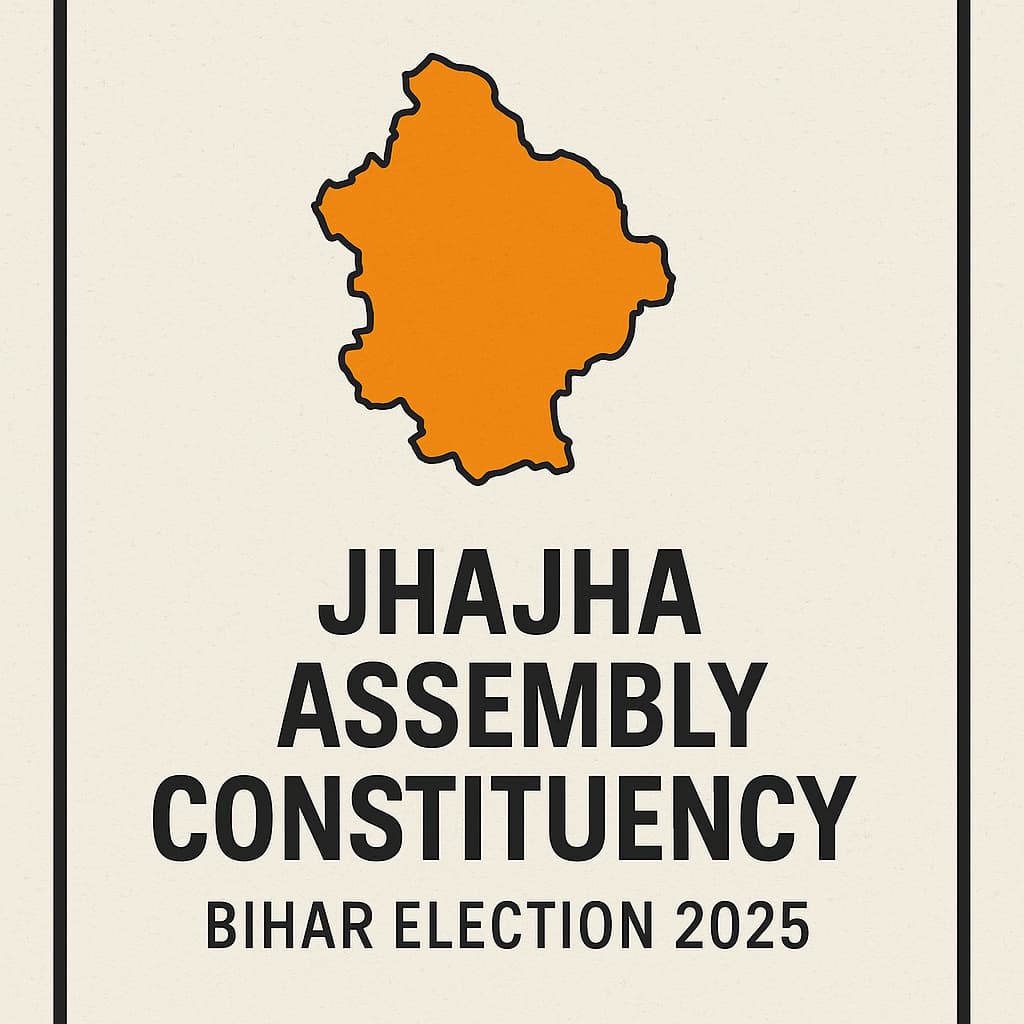
Jhajha Assembly Constituency (No. 242, Bihar)
Jhajha Assembly Constituency (No. 242), located in the southern part of Bihar’s Jamui district, holds strategic importance both geographically and politically. Positioned near the Jharkhand border, the constituency serves as a gateway between Bihar’s southern plains and the adjoining plateau region, shaping its distinct socio-economic and cultural character. The area presents a blend of semi-urban settlements, forested zones, and agrarian villages, reflecting the broader development contrasts of southern Bihar.
Economically, Jhajha’s population relies heavily on agriculture, small-scale trade, and labour migration, with a significant portion of its workforce seeking employment in other states. The railway junction at Jhajha town adds a notable urban element, enhancing connectivity and stimulating local commerce, education, and services. Over time, the town has emerged as a regional hub for transportation, education, and administration, while the surrounding rural areas continue to face challenges related to irrigation, rural infrastructure, and healthcare access.
Socially, Jhajha constituency is characterised by a diverse demographic composition, including significant OBC, SC, and minority populations, along with upper-caste and tribal communities in certain pockets. This diversity underpins its complex electoral arithmetic, where community alignments, youth aspirations, and development delivery often outweigh purely ideological loyalties.
Politically, Jhajha has demonstrated fluid and competitive voting behaviour, frequently alternating between different parties and candidates. The seat has been contested vigorously by both state and national parties, including the Janata Dal (United), Rashtriya Janata Dal (RJD), and Bharatiya Janata Party (BJP), reflecting its role as a barometer of political mood in southern Bihar. Recent elections have seen an increased emphasis on governance performance, employment opportunities, and connectivity, marking a gradual shift from traditional caste-based voting to issue-driven politics.
In essence, the Jhajha Assembly constituency encapsulates the evolving face of rural-modern Bihar—where the persistence of agrarian livelihoods intersects with growing expectations for urban-style amenities, better governance, and inclusive development.
Jhajha Assembly Election 2025
Jhajha Assembly Election 2025: Candidate Overview
This section will provide a brief introduction to the candidates representing different parties in the Jhajha Assembly election.
Jhajha Assembly Constituency Election Result 2025
Here, we will summarise the results from various sectors within the Jhajha constituency.
1. Foundational Details
- District & Number: Located in Jamui district, Jhajha is designated as Assembly Constituency No. 242 in Bihar.
- Lok Sabha Segment: It falls under the Jamui (Lok Sabha constituency).
- Reservation Status: General category (no reservation for SC/ST).
- Electorate: In the 2020 Assembly election, the number of registered electors was approximately 3,16,049 (comprising about 1,67,003 male, 1,49,044 female and 2 third-gender voters).
- Geographical Character & Connectivity: The constituency covers Jhajha town and adjoining rural blocks in Jamui district. The town lies near the Jharkhand border and serves as a small market and railway junction. The terrain includes agricultural plains and proximity to forested/plateau-edge zones.
- Urban–Rural Mix & Governance: Jhajha town acts as the local urban centre, while much of the constituency’s electorate resides in villages and panchayats. Gram panchayats, block development offices, and the district administration of Jamui carry out local governance.
2. Electoral History & Trends
- Recent Outcomes
- In 2020, Damodar Rawat of the Janata Dal (United) (JD(U)) won the Jhajha seat, securing 76,972 votes (~39.55% share) against the Rashtriya Janata Dal (RJD) candidate Rajendra Prasad who polled 75,293 votes (~38.69%). The margin was slender: 1,679 votes (approx. 0.9% of the vote).
- In 2015, the seat was won by Rabin Yadav of the Bharatiya Janata Party (BJP) with 65,537 votes (~40.04%), defeating Damodar Rawat (JD(U)), who got 43,451 votes (~26.55%). Margin: about 22,086 votes.
- Earlier (2010), Damodar Rawat (JD(U)) had won with 48,080 votes (~38.74%).
- Pattern & Trends
- The seat has oscillated among parties: JD(U), BJP and RJD have all held it in recent cycles, indicating competitiveness and local volatility.
- The 2020 result’s very narrow margin suggests intensifying contestation and a potentially fragmented vote base.
- Increase in electorate size and valid votes over time: e.g., valid votes ~1.22 lakh in 2010, ~1.94 lakh in 2020.
- Delimitation & Historical Context
- Under the delimitation order of 2008, the present boundaries and numbering (242) appear to have been reaffirmed.
- Historically, the constituency has seen frequent changes in party representation and local leadership.
3. Social & Economic Fabric
- Caste, Community & Religion
- The district and constituency comprise a mix of communities: Scheduled Castes, OBCs, upper castes, and a smaller minority Muslim presence. While precise caste percentages for the constituency are not fully available, broader district data indicate that SCs constitute around 13–17%.
- Religion: Predominantly Hindu; Muslims and other minorities present in town/ward clusters.
- Livelihoods & Economy
- Agriculture forms the backbone: small and marginal farms cultivating paddy, maize, pulses and wheat. Dependence on monsoon and limited irrigation remain structural issues.
- Jhajha town supports small-scale trade and commerce, railway junction activities, and service employment. Many households may depend on seasonal migration for their livelihood.
- Education & Literacy
- The town itself shows higher literacy rates (e.g., Jhajha town’s literacy ≈79.13% as per 2011 census) whereas surrounding rural parts lag behind.
- Urban–Rural Divide & Demographics
- The town provides better access to services and connectivity than surrounding villages, where infrastructure may be weaker. Youth and women voters are becoming more electorally prominent, often prioritising jobs, education and connectivity.
- Economic Stratification
- A divide exists between relatively better-off small/medium farmers and landless labourers or marginalised households. Access to welfare schemes, migration remittances and service employment vary across socio-economic strata.
4. Ground-Level Issues & Governance
- Infrastructure & Connectivity
- While major rail lines and road links connect Jhajha town, many hinterland villages continue to face a deficit in all-weather roads, electricity, and mobile/internet access.
- Agriculture & Irrigation
- Reliance on monsoon, inadequate canal/tube well coverage, small land-holdings, and low mechanisation hamper farmer income growth and resilience.
- Employment & Migration
- Limited local non-farm employment opportunities drive youth migration to urban centres within and outside Bihar.
- Education & Healthcare
- The town provides higher educational institutions, but many villages lack quality schools and local health centres; rural residents often travel for advanced services.
- Scheme Implementation & Governance
- Central/state schemes (housing, drinking water, rural roads) are active, but implementation gaps in remote wards hamper visible change.
- Local Governance & MLA Performance
- The sitting MLA’s access to the constituency, responsiveness to service issues and visible infrastructure work are key voter reference points. Given the narrow margin of victory in 2020, improvements or stagnation will heavily influence voter sentiment.
- Emerging Issues
- Youth employment, digital connectivity, urban expansion of Jhajha town, migration remittances, and border/transport-linked peripheral development (given proximity to Jharkhand) are increasingly relevant.
5. Political Actors & Party Dynamics
- Key Political Actor
- Damodar Rawat (JD(U)) is the current MLA as of 2020. His narrow victory underscores competitive footing.
- Major Parties
- JD(U) currently holds the seat; BJP has won earlier (2015); RJD remains a major challenger.
- Campaign Strategies & Issues
- Campaigns revolve around service delivery (roads, power, connectivity), agricultural support, youth aspirations, and the town-village infrastructure gap. Opposition often highlights neglected rural wards and agrarian distress.
- Mobilisation & Voter Bases
- Urban & town voters favour infrastructure and service-oriented messaging; rural villagers emphasise access to welfare, agriculture, and basic infrastructure. Caste and community networks remain relevant but are complemented by performance-based appeals.
- Independent/Smaller Party Impact
- Independents and smaller parties have occasionally won meaningful votes (e.g., in 2015, Binod Yadav as an independent had ~12.67% of the vote), indicating potential for vote fragmentation.
6. Strategic Electoral Analysis
- Voting Blocs & Behaviour
- Urban/town wards around Jhajha favour parties with credible infrastructure and governance narratives. Rural wards are more volatile and responsive to newly emerging issues (connectivity, jobs, welfare access).
- Youth and women are increasingly issue-driven, expecting visible development and opportunities beyond identity politics.
- Booth-Level Trends
- Booths closer to town and better connected tend to show higher turnout and typically favour the incumbent; remote booths with weaker access may register lower turnout or weaker swing potential.
- Candidate Effect & Margin
- The narrow 2020 margin (~1,679 votes) indicates that candidate reputation, local outreach and issue resonance matter significantly. Voter discontent or better challenger mobilisation could flip outcomes.
- External Influences
- State-level alliances, central scheme roll-outs, migration trends, and town expansion all influence sentiment. Changes in coalition configuration (e.g., those affecting JD(U), BJP or RJD) could alter local dynamics.
- Risk & Opportunity
- For the incumbent party, maintaining rural service-delivery momentum, expanding reach to hinterland villages and addressing youth aspirations are crucial. For opposition, consolidating rural vote banks, exploiting the narrow margin and offering a credible alternative could open space.
Forward-Looking Analysis
Jhajha’s future electoral landscape will increasingly centre on employment opportunities, digital and physical connectivity, education and youth engagement. As the constituency evolves, voters may prioritise tangible outcomes—jobs, services, infrastructure—over purely traditional ties.
Town-rural parity will be significant: If hinterland villages continue to lag in access, anti-incumbent sentiment could build. Meanwhile, the urbanising nodal town of Jhajha may steer votes via middle-class and aspirational segments. Opposition parties with credible local candidates and issue-focused campaigns may seize the opportunity given the slim victory margin.
State-level alliance dynamics and the strength of local party organisation will matter. In sum, while the seat currently leans towards the incumbent, evolving voter behaviour, demographic shifts and development performance mean a competitive contest should be expected in upcoming elections.
FAQs
What is the reservation status of the Jhajha Assembly constituency?
The Jhajha Assembly constituency (No. 242) is a General seat with no reservation for Scheduled Castes (SC) or Scheduled Tribes (ST). This open category allows candidates from all communities to contest. The constituency’s mixed social structure, including OBCs, upper castes, and minority groups, has made it a politically competitive and diverse seat, where multiple social segments actively shape electoral outcomes.
Who is the current MLA of Jhajha, and which party does he represent?
The current MLA of Jhajha is Damodar Rawat, representing the Janata Dal (United) or JD(U). He was elected during the 2020 Bihar Assembly elections, defeating his nearest rival, Rajendra Prasad of the RJD. Damodar Rawat’s tenure has focused on improving rural infrastructure, local governance, and education, though challenges such as employment opportunities and public amenities continue to influence voter sentiment across the constituency.
Which Lok Sabha constituency does Jhajha fall under?
The Jhajha Assembly segment is part of the Jamui Lok Sabha constituency (Parliamentary No. 40) in southern Bihar. The parliamentary seat includes other key assembly constituencies such as Jamui, Sikandra, Chakai, and Lakhisarai. The region holds political significance due to its diverse electorate and proximity to Jharkhand. It has been represented by several major national and regional parties, making it a crucial seat in the Bihar–Jharkhand political corridor.
What was the margin of victory in Jhajha in the 2020 Assembly election?
In the 2020 Bihar Assembly election, Damodar Rawat (JD(U)) secured victory in Jhajha with a margin of approximately 1,679 votes over Rajendra Prasad (RJD). The contest was closely fought, reflecting the constituency’s competitive political landscape and evenly divided voter preferences. The narrow victory margin highlighted the significance of grassroots campaigning, alliance strength, and local credibility in shaping the outcome.
What are the major issues facing voters in Jhajha?
Voters in Jhajha continue to face rural development challenges, including inadequate road connectivity, limited healthcare facilities, and limited access to irrigation and agri-inputs. The lack of local non-farm employment opportunities forces many youths to migrate to other states for work. Moreover, the urban–rural disparity remains a major concern, with villages lagging behind Jhajha town in education, electrification, and digital access. Voters also demand greater focus on public infrastructure, welfare delivery, and transparency in governance.
Which voter communities are influential in Jhajha elections?
Jhajha’s electorate represents a mosaic of social groups, making it one of the most demographically diverse constituencies in southern Bihar. OBC communities such as Yadavs, Koeris (Kushwahas), and Kurmis hold considerable sway, while Scheduled Castes and Dalits form a strong and vocal segment. Upper-caste agrarian families, especially Rajputs and Bhumihars, influence voting in select areas. The Muslim minority population in Jhajha town adds to the political complexity. Increasingly, young voters and women are emerging as key swing constituencies.
What might shape the next election in Jhajha?
The next Assembly election in Jhajha is expected to be influenced by the performance of the sitting MLA, particularly in rural and backward wards. Critical factors will include progress in road connectivity, education, and job creation, alongside delivery of state schemes for farmers and youth. Voters are also likely to assess how coalition politics at the state level—especially between JD(U), BJP, and RJD alliances—translates into local benefits. Candidate image, credibility, and outreach will play a decisive role in determining the outcome.