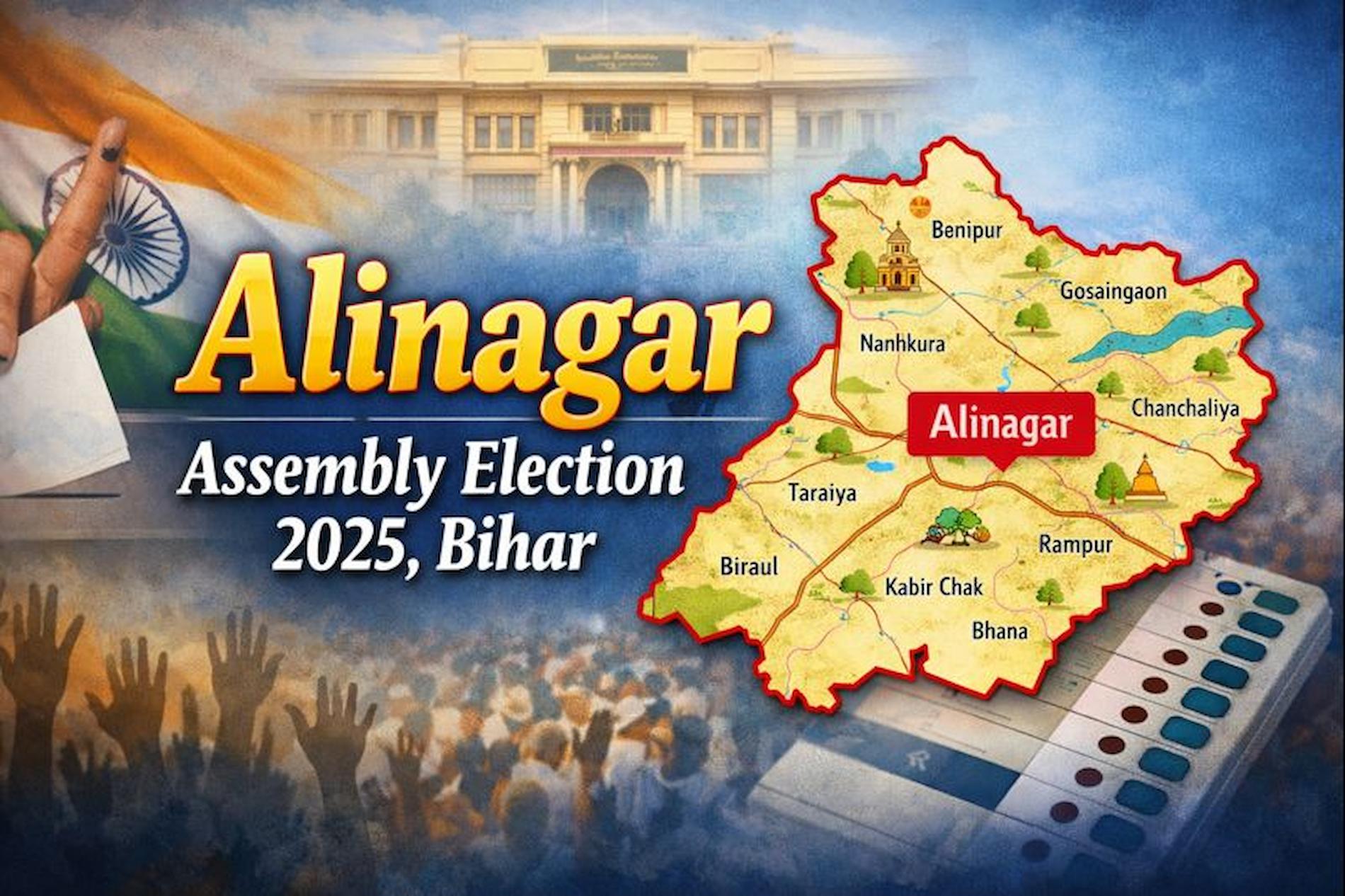
Alinagar Assembly Constituency (Vidhan Sabha) (Constituency No. 81), Bihar
Alinagar Assembly constituency, located in Darbhanga district of north Bihar, is a predominantly rural and agrarian seat shaped by migration, agriculture, and welfare-led politics. Lying within the Mithila region, Alinagar reflects the socio-economic realities of flood-prone north Bihar, where livelihood security, public services, and representation remain central to voter decision-making. As part of the Bihar Assembly elections 2025, the constituency is closely watched for how rural sentiment, caste alignment, and governance performance translate into electoral outcomes amid the broader Upcoming elections in India.
Bihar Assembly Elections 2025
Alinagar Assembly Election 2025 – Voting Date
Voting for the Bihar assembly elections 2025 for this constituency was completed on 11 November 2025, as part of Phase 2 of the 2025 Bihar Legislative Assembly election.
Alinagar Assembly Election 2025 Results
Maithili Thakur of the BJP won by 84915 votes in the Alinagar seat in the 2025 Bihar Vidhan Sabha elections.
The counting of votes and declaration of results for the 2025 Bihar Assembly elections were completed on November 14, 2025.
Candidates List: Alinagar Assembly Election 2025
| S.N. | Candidate | Party | EVM Votes | Postal Votes | Total Votes | % of Votes |
|---|---|---|---|---|---|---|
| 1 | MAITHILI THAKUR | Bharatiya Janata Party | 84611 | 304 | 84915 | 49.05 |
| 2 | RAJIPAL JHA | Aam Aadmi Party | 1484 | 0 | 1484 | 0.86 |
| 3 | BINOD MISHRA | Rashtriya Janata Dal | 72639 | 546 | 73185 | 42.27 |
| 4 | NAVIJAN ANSARI | Aam Janta Pragati Party | 671 | 0 | 671 | 0.39 |
| 5 | NOORUDDIN ZANGI | Social Democratic Party Of India | 310 | 2 | 312 | 0.18 |
| 6 | BIPLAW KUMAR CHOUDHARY | Jan Suraaj Party | 2259 | 16 | 2275 | 1.31 |
| 7 | SANJAY KUMAR JHA | Mithilawadi party | 418 | 4 | 422 | 0.24 |
| 8 | SITAMBAR SHARMA | Jagrook Janta Party | 331 | 0 | 331 | 0.19 |
| 9 | GANESH CHOUDHARY | Independent | 317 | 3 | 320 | 0.18 |
| 10 | CHANDU CHAUDHRY | Independent | 776 | 2 | 778 | 0.45 |
| 11 | SAIFUDDIN AHMED | Independent | 2792 | 11 | 2803 | 1.62 |
| 12 | HARI LAL SHARMA | Independent | 869 | 1 | 870 | 0.5 |
| 13 | NOTA | None of the Above | 4748 | 3 | 4751 | 2.74 |
| Total | 172225 | 892 | 173117 |
1. Foundational Details
- District: Darbhanga
- Lok Sabha Constituency: Darbhanga
- Constituency Number: 81
- Seat Type: General (Unreserved)
- Total Electors (2020): Approximately 2.85 lakh
- Voter Turnout (2020): Around 54%
Geography and Administrative Divisions
Alinagar is situated in the eastern part of Darbhanga district and includes the Alinagar Community Development Block along with surrounding gram panchayats. The region is characterised by flat alluvial plains, intersected by small rivers and canals connected to the Kamla–Balan river system. Seasonal flooding and waterlogging affect agriculture and road connectivity, especially during the monsoon months.
Administratively, the Alinagar constituency is governed through panchayati raj institutions, block offices, and district-level departments based in Darbhanga town. Road connectivity has improved in recent years, but interior villages still face access challenges to healthcare, markets, and higher education.
Economic Base
The economy of Alinagar is primarily agriculture-dependent, with paddy, wheat, maize, and pulses as the main crops. Limited irrigation infrastructure makes farming heavily reliant on monsoon rainfall. Livestock rearing and small-scale trading supplement rural incomes.
A significant share of households depends on seasonal and long-term migration to urban centres such as Delhi, Mumbai, and Punjab. Remittances form a critical component of the local economy, influencing consumption, housing, and education spending.
2. Electoral History and Political Background
Alinagar has traditionally been a competitive constituency, witnessing contests mainly between the Rashtriya Janata Dal (RJD) and Janata Dal (United), with the Bharatiya Janata Party (BJP) playing a supporting role through alliances. Electoral outcomes here often reflect broader Political trends in Bihar, especially shifts in rural OBC and minority voting behaviour.
Recent Election Results
| Year | Winning Candidate | Party | Runner-Up | Party | Margin (Votes) | Turnout (%) |
|---|---|---|---|---|---|---|
| 2020 | Mishri Lal Yadav | RJD | Binay Kumar Chaudhary | JD(U) | 31,000 | 54 |
| 2015 | Mishri Lal Yadav | RJD | Chandan Kumar | LJP | 24,000 | 56 |
In the Bihar assembly election 2025, Alinagar’s past results are often cited to understand continuity and change. In 2020, Mishri Lal Yadav of RJD secured a decisive victory, reaffirming RJD’s organisational strength and social base in the constituency. His earlier win in 2015 had already positioned him as a dominant local figure.
Historical Trends
Since delimitation, Alinagar has leaned towards RJD dominance, supported by Yadav and minority voters. JD(U) has remained competitive, especially during periods of strong state-level governance appeal. Congress and smaller parties have seen limited success, largely influencing margins rather than outcomes.
Electoral contests here are shaped less by urban issues and more by welfare delivery, caste alignment, and leaders’ accessibility to local voters, themes that frequently appear in political news in Bihar during election cycles.
Prominent Political Figures
- Mishri Lal Yadav (RJD): Sitting MLA, known for his grassroots presence and focus on rural welfare issues.
- Binay Kumar Chaudhary (JD-U): Senior local leader with influence among EBC groups.
These figures continue to shape political developments at the constituency level in Bihar, especially in the run-up to elections.
3. Social and Economic Fabric
Demographic Composition
- Population: Approximately 3.9 lakh (projected from Census 2011).
- Urban–Rural Ratio: Nearly 95% rural and 5% semi-urban.
- Gender Ratio: Around 911 females per 1,000 males.
- Literacy Rate: About 56%, below the state average.
Caste and Community Profile
Alinagar’s electorate is socially layered and politically active.
- OBCs: Yadavs form the largest and most influential group.
- EBCs: Include communities such as Nonia, Teli, and Mallah.
- Muslims: A significant minority, playing a decisive role in close contests.
- Scheduled Castes: Concentrated in rural hamlets, responsive to housing and welfare schemes.
The social structure of Alinagar aligns closely with patterns seen across many Bihar constituencies, where rural identity and community networks shape political mobilisation.
Livelihood Patterns
Agriculture remains the backbone of employment, though land fragmentation and low productivity limit income growth. Migration-based earnings, government welfare schemes, and daily wage labour are essential to household survival. Youth aspirations increasingly centre on education, government jobs, and stable non-farm employment.
4. Ground-Level Issues and Governance
Key Local Issues
- Flooding and Drainage: Recurrent waterlogging damages crops and rural roads.
- Employment and Migration: Lack of local industry pushes youth to migrate out of state.
- Education: Shortage of higher secondary schools and colleges within the constituency.
- Healthcare: Primary health centres exist but lack staff and equipment.
- Infrastructure: Interior roads, drinking water supply, and sanitation remain uneven.
Governance and Representation
The sitting MLA’s performance is evaluated mainly on access to welfare schemes, road construction, and responsiveness to village-level concerns. Schemes such as PM Awas Yojana, PDS, Ujjwala, and Jal Jeevan Mission have reached many households, though gaps persist in the quality of implementation.
As Political updates in Bihar increasingly focus on rural service delivery, Alinagar’s voters continue to demand visible improvements in education, healthcare, and employment opportunities.
5. Political Actors and Party Dynamics
- RJD: Dominant force, supported by Yadavs and minority voters.
- JD(U): Main challenger, drawing support from EBCs and sections of rural voters.
- BJP: Influential through alliances and cadre support.
- Smaller Parties and Independents: Limited presence, mainly affecting vote margins.
The constituency remains an important reference point in discussions around Politicians in Bihar and their rural support bases, especially during high-stakes elections.
6. Strategic Electoral Analysis
Alinagar’s voting behaviour is shaped by caste consolidation, perceptions of welfare, and candidate accessibility. High rural turnout and strong community networks favour parties with deep organisational roots.
RJD’s consistent victories reflect its ability to maintain social coalitions, while JD(U) aims to expand its reach through governance messaging. These dynamics are closely tracked in Alinagar elections news 2025 and wider political developments in Bihar.
Booth-level patterns indicate stronger turnout in villages with better road access, while turnout in remote areas lags due to logistical challenges.
7. Forward-Looking Analysis
As the state moves toward the next electoral cycle, Alinagar’s political future will depend on how effectively parties address migration, education, and flood management. Rising youth participation and digital awareness are slowly reshaping expectations, pushing leaders toward accountability and development-focused narratives.
The constituency’s outcome will inform interpretations of the 2025 Bihar election results and the overall outcome, making it a key rural seat to watch. Discussions around election news, Alinagar, Alinagar election results 2025, and broader Bihar election updates will place this constituency within the larger frame of Political trends in Bihar during the Bihar Assembly elections 2025 and the wider Upcoming elections in India.
FAQs About Alinagar Assembly Constituency
What is the reservation status of Alinagar Assembly constituency?
Alinagar is classified as a General category seat, meaning it is not reserved for candidates from the Scheduled Castes (SC) or the Scheduled Tribes (ST). Situated in the Darbhanga district of Bihar, the constituency serves a population that is almost entirely rural, with the 2011 Census recording 0% urban inhabitants. While the seat is open to all, the demographic balance is heavily influenced by Muslim, Yadav, and Brahmin voters who play a pivotal role in local polling. The constituency consists of the Alinagar, Tardih, and Ghanshyampur blocks, which were reorganized during the 2008 delimitation process.
Who is the current MLA of Alinagar?
As of the most recent 2025 Bihar Assembly elections, Maithili Thakur of the Bharatiya Janata Party (BJP) is the current MLA, having secured a notable victory with approximately 49% of the vote. She succeeded Mishri Lal Yadav, who had a complex political tenure; he won in 2020 on a Vikassheel Insaan Party (VIP) ticket before defecting to the BJP in 2022 and eventually resigning in late 2025. The shift from veteran politicians to a younger, culturally prominent figure like Thakur represents a significant change in the local leadership. Her win marked a “hold” for the BJP/NDA alliance in a region that has historically seen tight contests.
Which Lok Sabha constituency does Alinagar fall under?
Alinagar is one of the six assembly segments that constitute the Darbhanga Lok Sabha constituency, a central political hub in North Bihar. It shares this parliamentary constituency with other segments such as Benipur, Gaura Bauram, and Darbhanga Rural, making it a critical piece of the broader electoral puzzle. Currently, the Darbhanga parliamentary seat is represented by Gopal Jee Thakur of the BJP, who maintained a strong lead in the Alinagar segment during the 2024 General Elections. The interplay between state-level local issues and national parliamentary trends often dictates the campaigning strategies used within Alinagar.
What are the main issues faced by voters in Alinagar?
The most pressing concern for Alinagar voters is the recurring seasonal flooding, as the region’s geography makes it highly susceptible to devastation from North Bihar’s rivers. This environmental challenge is compounded by high unemployment, which forces many youth to migrate to cities like Delhi and Mumbai in search of work. Infrastructure gaps, particularly in healthcare and higher education, remain significant hurdles for the local population, who often have to travel to Darbhanga city for basic services. Additionally, the lack of local industries means the economy remains stagnant, stuck between subsistence farming and remittances from abroad.
How has Alinagar’s political trend evolved?
Since its creation in 2008, Alinagar has evolved from a predictable RJD stronghold into a highly competitive battleground between the NDA and the Mahagathbandhan. In the early years, Abdul Bari Siddiqui of the RJD dominated the seat, but the rise of the BJP and its allies, like the VIP, has since fractured that traditional base. Recent elections show a “see-saw” trend: the RJD won in 2015, the VIP (aligned with NDA) took it in 2020, and the BJP secured it in 2025. This evolution highlights a shift in which voters are increasingly moved by alliance arithmetic and the individual “celebrity” or “strongman” appeal of candidates rather than by party loyalty alone.
What drives the economy of Alinagar?
The local economy is almost exclusively powered by agriculture, with paddy, wheat, and maize cultivation as the primary livelihoods. Beyond traditional crops, the region is famous for Makhana (fox nut) and Mango production, which provide seasonal income but suffer from a lack of modern processing units. A massive secondary pillar of the economy is remittances from workers in other states, which sustain many rural households. Small-scale rural trade and livestock rearing also contribute to the local market, though the lack of urban centers limits commercial expansion.
What could shape the next election outcome in Alinagar?
Future election results will likely hinge on the incumbent’s ability to deliver flood protection infrastructure and create local jobs to stem the tide of migration. The “women’s vote” has become a decisive factor in Bihar, and candidates who prioritize social welfare schemes and safety are expected to gain a significant edge. Furthermore, the caste-based mobilization of the Muslim-Yadav (M-Y) factor versus the EBC-Brahmin consolidation will remain the primary mathematical challenge for any party. Ultimately, Alinagar’s voters are increasingly looking for a representative who can bridge the gap between traditional rural life and modern developmental needs.